


Dear Investor.
Zee here. You would know that JPMorgan Chase is one of American’s largest global bank. But here’s something wild: JPMorgan Chase’s earliest roots trace back to 1799, when it started as a water company. Yes, you read that right a water company!
The Beginning: 1799
After a yellow fever outbreak in New York City, founding fathers Alexander Hamilton and Aaron Burr came together to create the Manhattan Company to provide clean water to residents. But Burr cleverly included a clause that allowed the company to use “excess capital” for other business ventures. Six months later, they opened a bank—the Bank of the Manhattan Company. This became one of the oldest banks in America.
Enter J.P. Morgan: 1871
Fast forward to 1871, when legendary financier J. Pierpont Morgan teamed up with Philadelphia banker Anthony Drexel to create Drexel, Morgan & Co. This firm became a powerhouse in investment banking, helping finance America’s railroads, steel industry, and major infrastructure projects like the Panama Canal. Morgan himself became one of the most influential figures in American finance, even stepping in to stabilize financial markets during the Panic of 1907.
Chase National Bank: 1877
In 1877, another piece of the puzzle appeared when John Thompson founded Chase National Bank, named after President Lincoln’s Treasury Secretary, Salmon P. Chase. By 1930, it was the largest bank in the world.
The Modern JPMorgan Chase: Mergers Create a Giant
The bank we know today is the result of massive consolidation:
1955: Chase National Bank merged with the Bank of the Manhattan Company to form Chase Manhattan Bank
2000: J.P. Morgan & Co. merged with Chase Manhattan to create JPMorgan Chase & Co.
2004: JPMorgan Chase acquired Bank One, bringing in current CEO Jamie Dimon
2008: During the financial crisis, JPMorgan acquired Bear Stearns and Washington Mutual, becoming even larger
Today’s Banking Powerhouse
JPMorgan Chase is now:
The largest bank in the United States
The world’s fifth-largest bank by total assets (about $4.4 trillion!)
A major player in investment banking, consumer banking, credit cards, and asset management
Led by CEO Jamie Dimon, who recently announced he plans to stay for at least five more years
The bank serves millions of consumers, small businesses, and major corporations in over 60 countries. It’s built on a foundation of more than 1,200 predecessor institutions that have merged over 225 years.
Announcement:
Join us on Wednesday 4th March 2026, for our live Free webinar “Netflix Down 39%: Opportunity or Trap?”.
👉🏼 Click here to reserve a spot. (LINK)
Here is 5 Things About JPM Stock Right Now
1. The Stock Just Hit an All-Time High
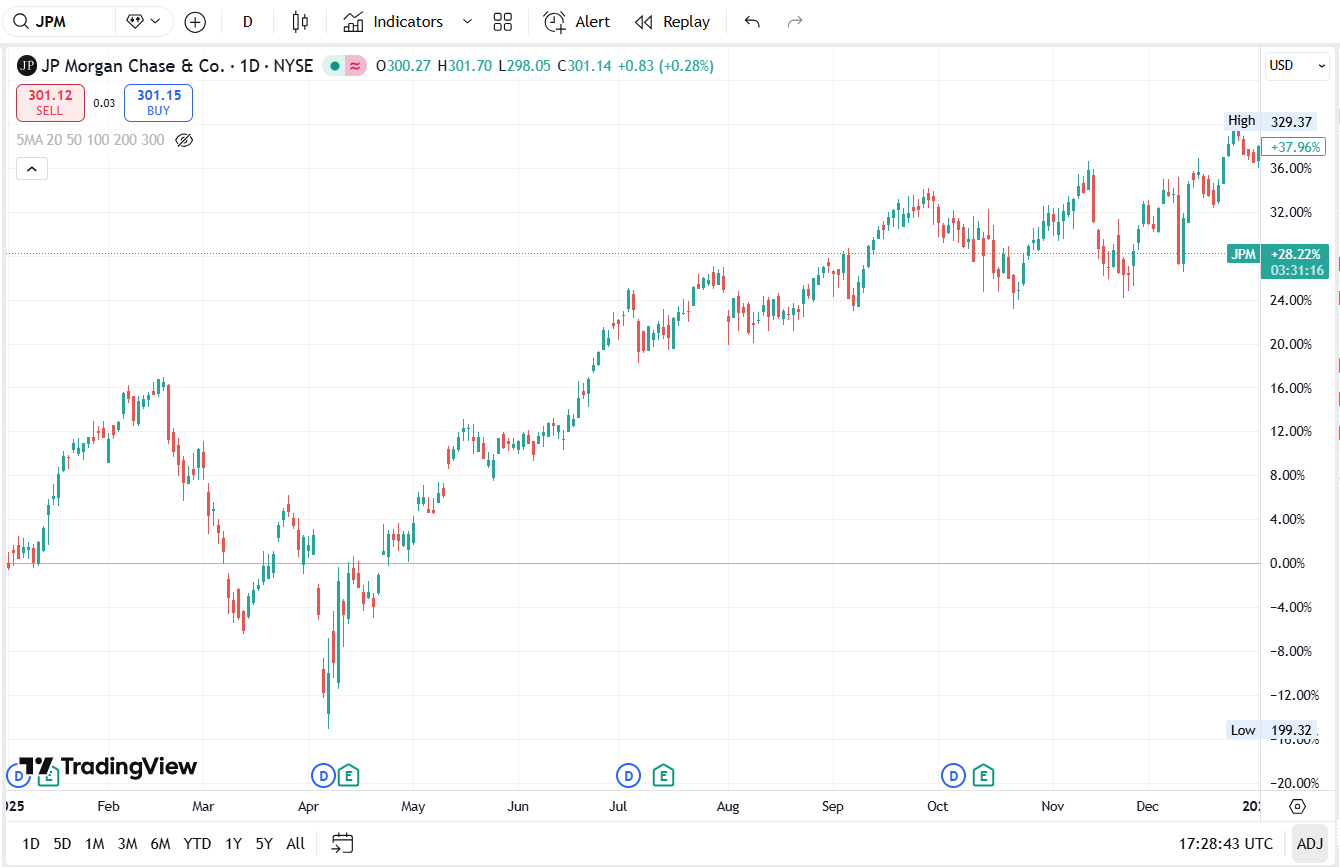
JPMorgan’s stock recently reached a record price of $337.25 in early January 2026. That’s pretty impressive! The stock has climbed about 23% over the past year, showing strong momentum.
As of late January, it’s trading around $297-312 per share. Why the excitement? Investors are feeling optimistic about interest rates stabilizing and the economy staying strong, which is good news for banks.
2. The Bank is Expecting Solid Growth
Here’s a key number to understand: Net Interest Income, or NII. Think of this as the money a bank makes from the difference between what it earns on loans and what it pays on deposits. JPMorgan expects its NII to be about $103 billion in 2026—that’s 2% higher than what analysts originally predicted.
Translation? The bank is doing better than expected at making money from its core business.
3. Recent Earnings Had a Mixed Story
The bank recently reported its fourth-quarter 2025 earnings. On the surface, earnings per share came in at $4.63, but there’s a catch, they had to set aside extra money for issues with the Apple Card program.
If you adjust for that one-time charge, earnings would have been $5.23 per share. The takeaway? The underlying business is healthy even though the reported number looked a bit lower.
4. Analysts Are Generally Bullish
Wall Street analysts who follow JPM closely have given it a “Buy” rating overall. Price targets from different firms range from $330 to $391, suggesting analysts think there’s still room for the stock to grow from current levels. Investment firms like Barclays and Bank of America Securities have recently raised their price targets, showing increased confidence in the bank’s prospects.
5. There Are Some Headwinds to Watch
No investment is perfect, and JPM faces some challenges. There’s political discussion about potentially capping credit card interest rates at 10%, which could hurt profitability in the bank’s consumer division. Additionally, if loan demand slows down or if competition for deposits heats up, that could squeeze profits. These are risks worth keeping an eye on.
Bottomline: What Does This Mean for Investors?
JPMorgan Chase is what investment professionals call a “blue chip” stock—a large, well-established company with a long track record. Here are some key points:
The Good:
Diversified business across many banking services
Strong management team with proven track record
Consistently profitable with solid dividend payments (currently yielding about 2%)
History of weathering economic storms
The Things to Consider:
The stock price has run up quite a bit, so it may be expensive relative to some competitors
Banking stocks can be sensitive to economic conditions and interest rates
Regulatory changes and political decisions can impact profitability
Disclaimer: All information here is for educational purposes only. This is not financial advice. Please do your own research and speak with a licensed advisor before making any investment decisions. Past performance is not indicative of future returns. How we invest may not suit your investment goals and risk management profile.