

Dear Investor.
Zee here. If you’re new to investing, Netflix is one of those companies that feels familiar, you probably use it every day. But understanding Netflix as an investment is different from understanding it as a streaming service.
Let’s break down what’s happening with Netflix stock in simple terms.
Announcement:
Join us on Monday 9th Feb 2026, for our live Free webinar “One CEO, Two Universes: Tesla Today, SpaceX Tomorrow?”.
👉🏼 Click here to reserve a spot through our Whatsapp Community. (LINK)
(Zoom link and reminders will be sent via the community)
1. Netflix Just Made Its Biggest Move Ever: Buying Warner Bros. for $83 Billion
In December, Netflix announced they’re buying Warner Bros., HBO, and HBO Max for roughly $83 billion in cash. This is massive.
To put this in perspective: Netflix spent about a decade saying they were “builders, not buyers.” They preferred creating their own content rather than acquiring other companies. This deal completely flips that script.
What are they getting? Basically, Hollywood history. Warner Bros. owns DC Comics (Batman, Superman), Harry Potter, Game of Thrones, The Sopranos, and nearly 100 years of films and TV shows. They’re also getting HBO Max, a competing streaming service.
Why does this matter to investors? It shows Netflix is willing to make bold bets when they see value. Whether this pays off remains to be seen, but it’s definitely the biggest strategic shift in the company’s history.
2. The Core Business Is Still Crushing It
Before we get too focused on the Warner Bros. deal, let’s talk about Netflix’s actual performance, because it’s really good.
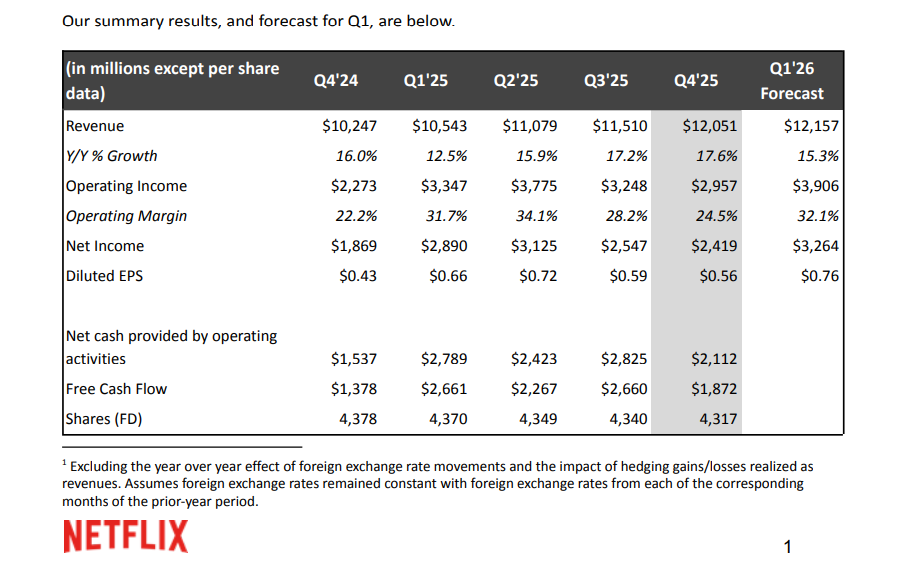
In Q4 2025, Netflix brought in $12.05 billion in revenue (up 18% from the previous year) and generated nearly $3 billion in operating income. They now have over 325 million paid subscribers worldwide.
For the full year 2025, Netflix generated $45.2 billion in revenue and produced $9.5 billion in free cash flow. Free cash flow is money the company actually has left over after paying all its bills, this is what allows companies to invest in growth, pay dividends, or in Netflix’s case, make giant acquisitions.
Netflix isn’t buying Warner Bros. because their streaming business is struggling. They’re doing it from a position of strength.
3. The Advertising Business Is Growing Fast
Remember when Netflix said they’d never have ads? They changed their mind, and it’s working out nicely.
Netflix’s ad-supported tier generated over $1.5 billion in 2025, that’s 2.5 times more than the previous year. Looking ahead to 2026, they expect ad revenue to double again to around $3 billion.
Why does advertising matter? Because it opens up a new revenue stream. Instead of just collecting monthly subscription fees, Netflix can now also sell advertising space. This is particularly important for attracting price-sensitive customers who might not pay $15-20/month but will happily watch ads to pay $7/month instead.
Advertising revenue is still small compared to Netflix’s overall business (less than 5% of total revenue), but it’s growing rapidly and could become a major profit driver in the future.
4. Netflix Has Learned an Expensive Lesson About Ownership
Here’s the most interesting strategic insight from recent events: Netflix has realized that making other people’s content popular is a terrible business model.
Consider these examples:
Breaking Bad: When this AMC show first aired, it had modest ratings. Then Netflix licensed it for streaming, and their algorithm introduced millions of new viewers to Walter White’s journey. The show became a cultural phenomenon, which helped AMC launch the hit spinoff “Better Call Saul” and negotiate higher licensing fees. Netflix did the heavy lifting of building the audience, but AMC owned the franchise and captured all the long-term value.
The Office: Netflix paid NBCUniversal about $100 million per year to stream this sitcom, and it became Netflix’s most-watched show for years. Fans watched it obsessively, turning it into comfort-watch gold. Then NBCUniversal took it back to launch their own streaming service, Peacock, using the audience Netflix had cultivated. Netflix spent half a billion dollars over five years essentially marketing someone else’s asset.
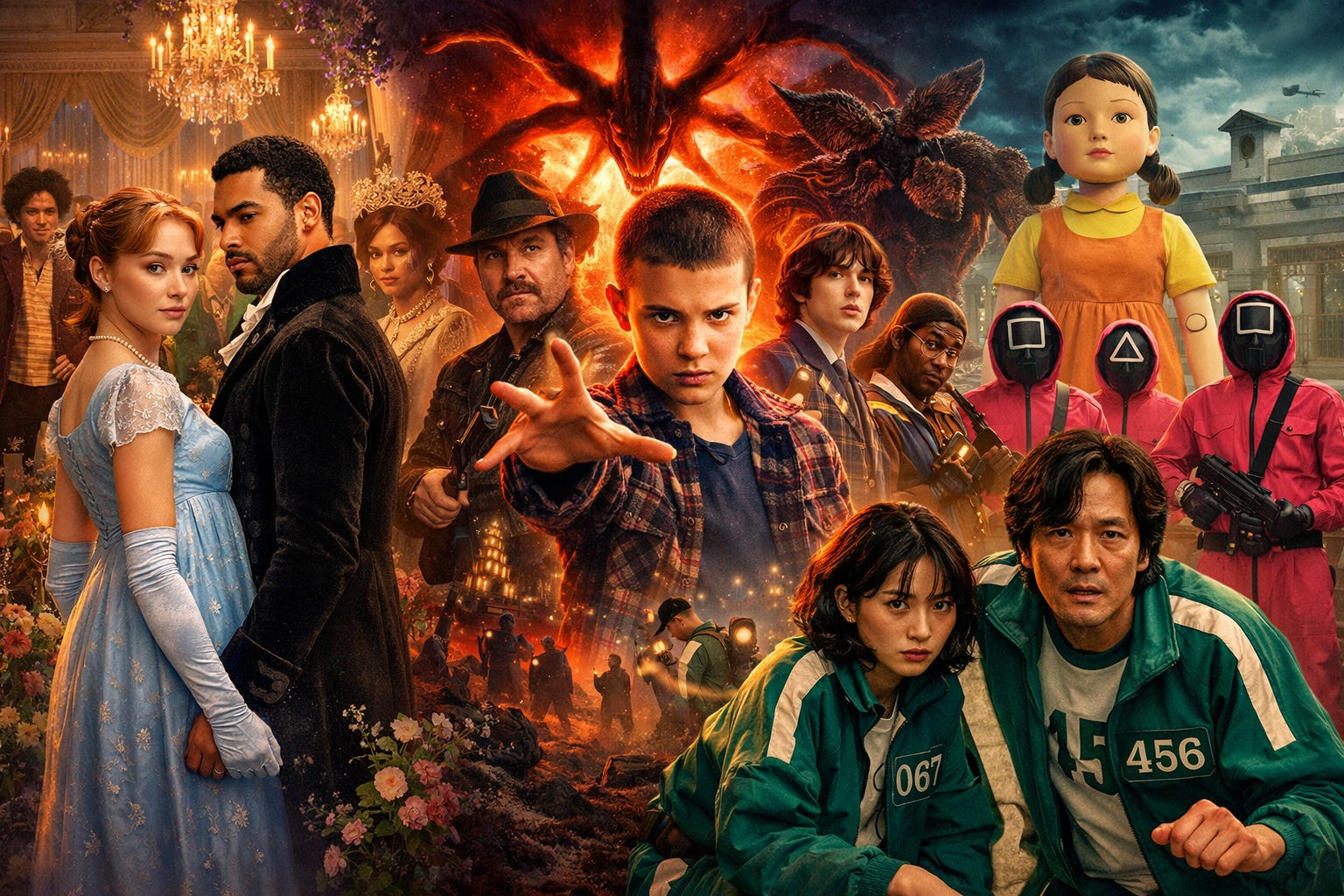
Squid Game (owned by Netflix): When Netflix actually owns content that becomes popular, they capture everything. This Korean thriller became a global sensation, generating Halloween costume sales, mobile game deals, a reality competition spinoff, and immersive experiences in major cities worldwide. Netflix owns it all—the IP, the characters, the universe, and every revenue stream that flows from it.
Stranger Things (owned by Netflix): Another Netflix-owned property that demonstrates the power of ownership. This 1980s nostalgia sci-fi series spawned merchandise deals with Target, Hot Topic, and countless other retailers, a stage play, video games, board games, and boosted sales of Eggo waffles by 14%. Because Netflix owns it, every Demogorgon action figure sold and every “Hellfire Club” t-shirt purchased generates revenue for Netflix, not some other studio.
Bridgerton (owned by Netflix): This Regency-era romance drama became a cultural phenomenon, sparking a massive increase in sales of corsets, empire-waist dresses, and period romance novels. It launched successful spinoffs like “Queen Charlotte,” a classical music soundtrack that hit streaming charts, a musical concert experience, and a makeup collaboration with Pat McGrath Labs. Netflix captures all of this—from the fashion collaborations to the ball experiences popping up in cities worldwide.
The Warner Bros. acquisition is Netflix saying: “We’re tired of making other people rich. Let’s own the library instead.”
5. How Netflix Got Here: A Brief History
If you’re new to investing, it helps to understand Netflix’s journey because it shows how companies evolve:
1997-2007: The DVD Era – Netflix started as a DVD-by-mail service. You’d order movies online, they’d mail them to you in those iconic red envelopes, you’d watch them, mail them back. This was revolutionary compared to driving to Blockbuster and paying late fees.
2007-2012: The Streaming Shift – Netflix launched streaming. Traditional media companies thought it was a joke. Blockbuster went bankrupt. Netflix proved the future was digital.
2013-2020: Becoming a Studio – Netflix started producing original content like “House of Cards” and “Stranger Things.” Hollywood initially mocked this, but Netflix proved they could create hits. They went from just delivering content to actually making it.
2020-2025: The Mature Phase – Netflix cracked down on password sharing, launched an ad-supported tier, and entered live sports (like their WWE deal). They focused on profitability and cash generation rather than just growth-at-any-cost.
2025-Present: The Buyer Era – With the Warner Bros. acquisition, Netflix is entering a new phase: consolidation. They’re using their cash-generating machine to buy content libraries and intellectual property rather than building everything from scratch.
Bottomline: What Does This Mean for Investors?
Netflix is guiding for $50.7-51.7 billion in revenue for 2026 (up 12-14%), operating margins of 31.5%, and about $11 billion in free cash flow. Those are strong numbers.
However, they’re also taking on significant debt to finance the Warner Bros. acquisition. The company secured over $67 billion in financing facilities, which will put leverage at about 3.8 times their operating income. They’ve also paused share buybacks to accumulate cash for the deal.
Netflix is betting big that owning premium content libraries is worth the price. The core streaming business is healthy and profitable, but integrating a century-old Hollywood studio is complex. This deal could accelerate Netflix’s growth or it could prove that the “builders, not buyers” philosophy was right all along.
For investors, Netflix represents a mature tech company making a bold strategic pivot. It’s no longer a high-growth startup; it’s a cash-generating machine placing a massive bet on content ownership. Whether that bet pays off will define the next chapter of the company’s story.
Disclaimer: All information here is for educational purposes only. This is not financial advice. Please do your own research and speak with a licensed advisor before making any investment decisions. Past performance is not indicative of future returns. How we invest may not suit your investment goals and risk management profile.
The Breaking Bad and Office examples really nail why this acquisition makes sense strategicly. Netflix trained audiences to love content they didnt own, then watched those IPs walk away to competitors. The shift from "builders not buyers" is intresting but logical given how much value they left on the table. Though 67B in financing at 3.8x leverage is definately bold after years focusing on cash generation.