

Dear Investor.
Zee here. Since November is my birthday month, I decided to write about my favorite toy company, which went through a very interesting turnaround. However, the Company is not publicly listed and remains privately owned.
Every parent has likely stepped on one. Every kid has lost one under the sofa.
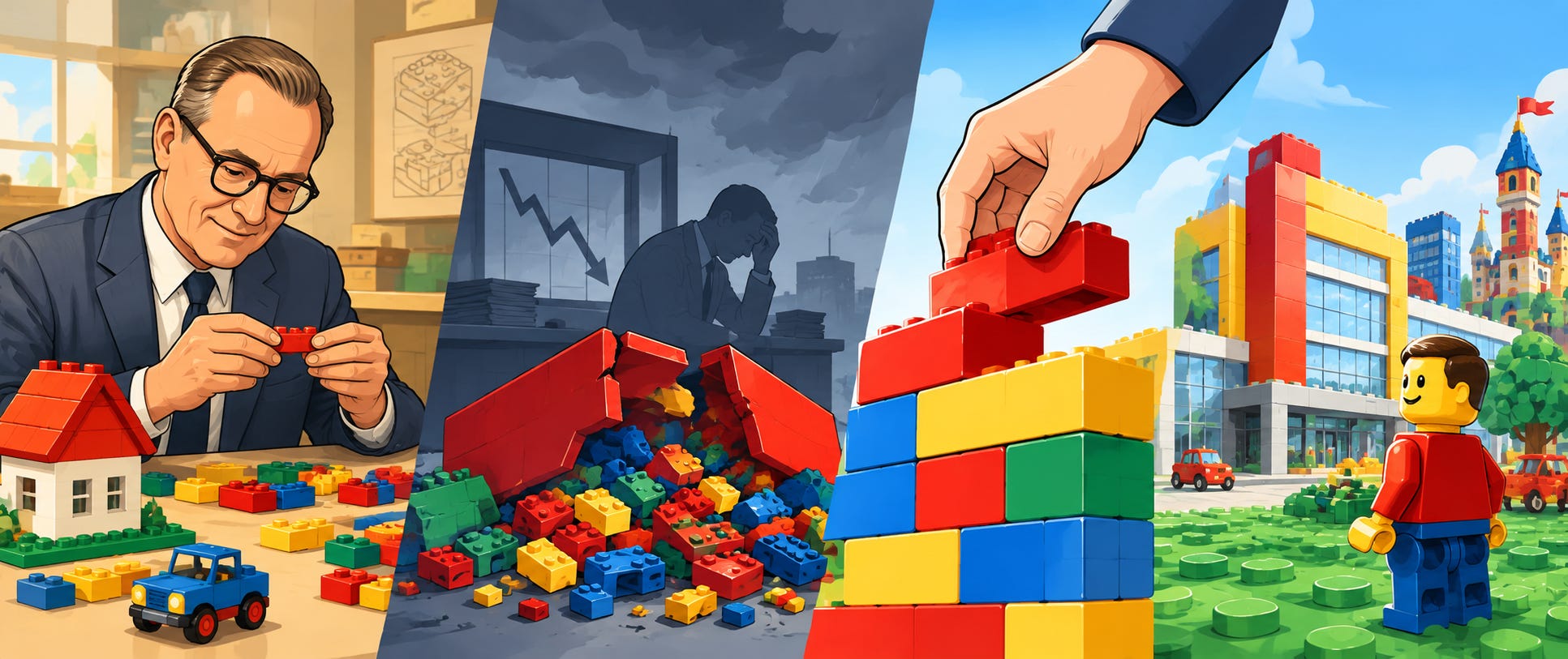
In 2003, the most beloved toy company in the world was running out of road. Sales were sliding, debt was piling up, and some people feared the company that had made the plastic brick famous might be sold off or broken up.
Yet within about ten years, that same company had become the biggest toy maker on the planet, overtaking giants like Mattel.
How does a business go from the edge of bankruptcy to the top of its industry, using the very same little brick?
The answer starts in a carpenter’s workshop in Denmark during the Great Depression, and it holds lessons for anyone who runs a business or invests in one.
It started with a carpenter
The story begins in 1932 in Billund, a tiny town in Denmark. Ole Kirk Kristiansen was a carpenter whose business was struggling. The Great Depression had hit, and nobody was ordering new furniture. So he started making smaller things: stepladders, ironing boards, stools, and a few wooden toys for children.
The toys sold. Parents might not have money for a new cupboard, but they still wanted something for their kids. Ole Kirk decided to focus on toys.
In 1934 he gave the company a name. He took two Danish words, leg godt, meaning “play well,” and squashed them together into LEGO. It was a motto as much as a name, and he insisted on high quality.
His son Godtfred reportedly remembered his father making him redo a batch of toys because the quality wasn’t good enough. That obsession with quality stayed with the company for good.
The plastic gamble
After World War II, Ole Kirk made a bold move. In 1947 he bought a plastic injection-molding machine from England. It was hugely expensive for a small village business, and many people thought plastic toys were a passing fad.
His company began producing small plastic bricks that could be pressed together. They were a decent idea, but they didn’t hold together well and didn’t always fit.
The real breakthrough came in 1958, when Ole Kirk’s son Godtfred patented the design we know today: studs on top and hollow tubes underneath. Bricks now clicked together firmly, but could still be pulled apart easily. That tiny change made the possibilities almost endless.
The company later said that even today, bricks made decades ago still fit with bricks made now.
Growing into a global giant
Two more things helped the company grow:
• A fire. In 1960 a fire destroyed the warehouse full of wooden toys. The company decided to stop making them and go all in on plastic bricks.
• Play became a system. LEGO sold sets as a “system of play,” meaning every piece worked with every other piece. A kid who got one set had a reason to buy another.
Over the following decades LEGO added wheels, train sets, the Technic line for older builders, and in 1978 the little minifigure with the smiling face.
The first LEGOLAND park opened in Billund, Denmark in 1968.
By the 1990s, LEGO was a household name around the world.
Then it all went wrong
By the early 2000s, LEGO was in serious trouble.
The world was changing. Kids were playing video games, and the old belief that children would always want bricks no longer felt safe.
LEGO responded by trying to be everything to everyone:
• It launched themes and product lines left and right.
• It made clothing, watches, video games and theme parks.
• It created thousands of special, unique pieces, many used in only one set.
It looked creative, but it was a mess. Production was complicated, costs ballooned, and the company was losing track of what made it special.
Sales fell sharply, and in 2003 and 2004 the losses were huge. In 2004 the company lost well over a $1billion Danish kroner (USD 150mil), and it was heavily in debt.
LEGO was close to collapse, and some people expected it to be sold or broken up.
The turnaround
In 2004 the family-owned company made an unusual choice. It put a 36-year-old named Jørgen Vig Knudstorp in charge. He was a former management consultant with no toy-industry career behind him, and he had been at LEGO only a few years.
His message was blunt: the company was on a “burning platform,” and it needed to change fast. His plan wasn’t flashy. It came down to a few simple moves:
1. Go back to the brick. LEGO stopped chasing every trend and refocused on what it did best.
2. Cut the clutter. The company cut the number of unique pieces dramatically and simplified how sets were designed, which saved a lot of money.
3. Sell what wasn’t core. It sold most of its LEGOLAND parks to a partner and sold or closed other side ventures.
4. Fix the money. LEGO cut costs, trimmed staff, reorganized its factories and supply chain, and paid down debt.
5. Listen to the customer. Instead of guessing, the company talked to kids and, importantly, to adult fans, who had long been ignored.
It wasn’t painless.
Many jobs were lost, and the changes were hard on people who had been there for years. But the numbers started to turn around.
A smarter kind of creativity
Once the foundation was fixed, LEGO got creative again, but this time with discipline:
• Licensed themes. Partnerships with franchises such as Star Wars, Harry Potter and Marvel brought in new fans.
• Fan power. Programs like LEGO Ideas let fans submit their own designs, and the best ones became real sets.
• Movies and games. The LEGO Movie in 2014 was a big hit and boosted the brand.
• Adults, too. Sets for grown-ups, such as detailed architecture models and even flower bouquets, opened up a whole new market.
By the mid-2010s LEGO had become the largest toy company in the world, overtaking giants such as Mattel. Its annual revenue today is many times what it was in the dark days of 2004.
What we can learn
LEGO’s story has a few simple lessons for any business:
• Know what you are. LEGO nearly died when it forgot it was a company about bricks.
• Complexity is expensive. More products, more parts and more projects can quietly drain a business.
• Quality lasts. The same standards Ole Kirk demanded in the 1930s still protect the brand.
• Listen to your fans. Some of LEGO’s best ideas came from the people who loved it most.
• Bold change is sometimes the only option. The company survived because it was willing to cut, simplify and start over.
What investors can learn
LEGO is privately owned, so ordinary investors cannot buy its shares. But its comeback shows how real turnarounds work, and what to watch for in listed companies.
• A turnaround is usually a return to basics. LEGO did not win with a clever new invention. It won by cutting complexity and focusing on its core product.
• Growth is not the same as profit. In the years before the crisis, LEGO launched more products, yet its profits fell. Rising sales with shrinking margins is a warning sign.
• A cheap price is not a bargain by itself. A struggling company is often cheap for a good reason. The question is whether it can actually be fixed.
• Debt decides how much time you have. LEGO’s patient family owners gave it room to restructure. A public company with heavy debt and short-term lenders may not get that luxury.
• Turnarounds take years. LEGO’s recovery played out over several years, not a few quarters. Investors who need a quick result are often disappointed.
How to spot a good turnaround
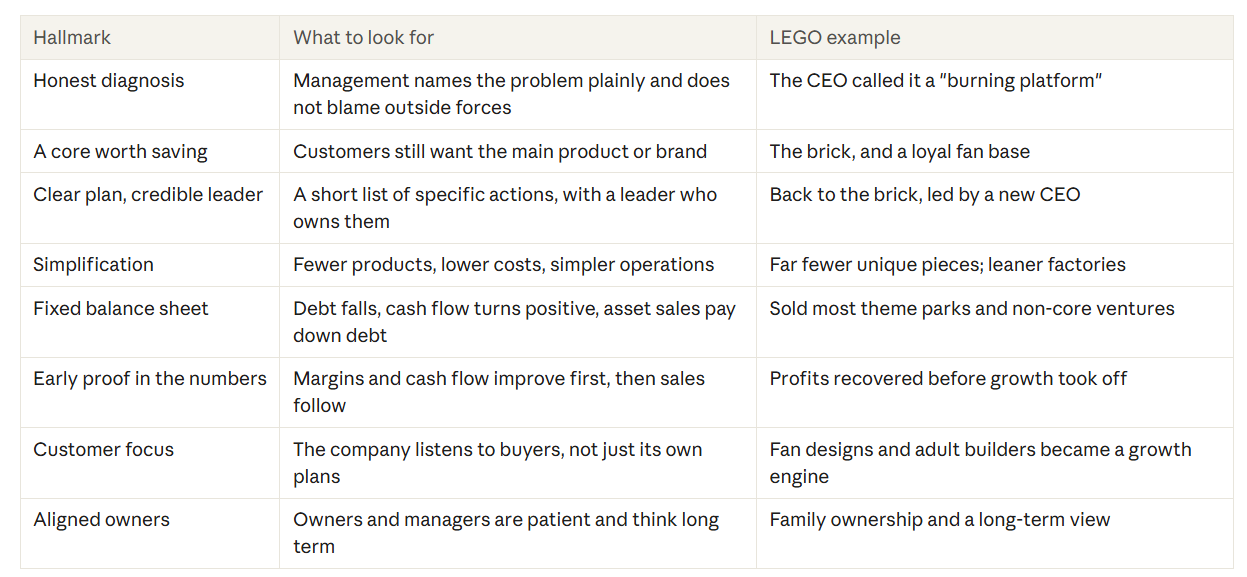
Red flags that a turnaround may not be real
• Management keeps announcing new strategies instead of finishing the old one.
• “One-time” restructuring charges appear year after year.
• Profits are propped up by asset sales or accounting gains, not by the core business.
• Debt keeps rising while sales keep falling.
• Growth comes mainly from acquisitions that hide a shrinking core.
• Leaders blame the economy, the weather or competitors every quarter.
A simple test: ask whether the company is doing fewer things better, or more things faster.
Disclaimer:
All information here is for educational purposes only. This is not financial advice. Please do your own research and speak with a licensed advisor before making any investment decisions. Past performance is not indicative of future returns. How we invest may not suit your investment goals and risk management profile.