

Dear Investor.
Zee here. You’ve probably heard this advice a hundred times: “Just ignore the market noise.” Good advice. Nearly impossible to follow.
When your portfolio turns red, your stomach churns. Your body’s fight-or-flight instinct doesn’t know the difference between a bear market and a bear. So you panic sell. Most new investors do. And in doing so, they lock in losses that the market would have eventually recovered from. Sometimes within months.
The problem today is that market noise is louder than ever. A decade ago, you might have caught the evening news and gone to bed. Now, push notifications buzz on your phone at midnight. Financial anxiety is no longer something you switch off at the end of the day, it follows you into the bedroom, the dinner table, and everywhere in between.
Here’s the uncomfortable truth: market noise is never going away.
Accepting this is actually the first step to becoming a better investor.
Announcement:
Join us on Wednesday 8th April 2026, for our live Free webinar “The Hidden Giant in Grab’s Business That Most Investors Overlook (Not Ride-Hailing)”.
👉🏼 Click here to reserve a spot. (LINK)
The Real Perspective
Consider Warren Buffett, arguably the greatest investor alive. Even he couldn’t escape losses. Berkshire Hathaway, his investment fund, experienced losses multiple times over the decades:
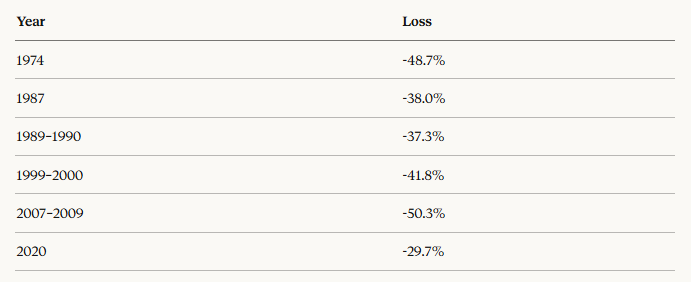
For a 50% crash, that means if you had $100,000 invested in Berkshire during the 2007–2009 financial crisis, it would have looked like just $50,000 on paper. Gut-wrenching by any measure.
Yet Berkshire survived every single crash, the 1970s inflation shock, Black Monday, the dot-com bubble, the global financial crisis and came out stronger each time. Buffett didn’t panic sell. He stayed the course.
The lesson isn’t that losses don’t hurt. It’s that time in the market consistently beats timing the market.
Today, with headlines swinging between geopolitical conflicts and recession fears, stocks are rattling around in correction territory. It sounds scary.
But in 20 years, today’s crisis will very likely be just another row in a historical table, much like the ones above.
The Frameworks To Staying Calm
1. Markets are driven just as much by emotion as fundamentals.
A company does not become 15% less valuable because of a headline. Earnings don’t evaporate overnight because of a geopolitical flare-up. Yet prices swing wildly anyway because markets are not just driven by balance sheets and revenue figures.
They are driven just as much by fear, hope, and uncertainty.
2. Volatility is not the problem. Emotional reactions to it are.
Volatility is simply the market repricing assets as new information and new emotions flood in. The real problem is the emotional reaction it triggers. The urge to act, to do something, to stop the bleeding. That urge, more than any market crash, is what destroys long-term returns.
The investor who stays calm and does nothing during a 20% drawdown almost always comes out ahead of the one who sold at the bottom and waited for certainty before buying back in. Certainty, of course, never comes.
3. When in doubt, zoom out and revisit your thesis.
The best thing any investor can do in a turbulent week is deceptively simple: zoom out, revisit your investment thesis, and ask yourself one honest question — has anything fundamentally changed in the businesses I own?
Not the share price. Not the headlines. The actual business. Its earnings power, its competitive position, its balance sheet. If the answer is no, then the noise is just noise.
The thesis still holds. The job is to hold with it.
4. Over time, markets have consistently rewarded patience.
Markets have endured world wars, financial collapses, pandemics, and political upheaval and over every sufficiently long period, they have rewarded those who stayed invested.
Not the most sophisticated. Not the most active. The most patient.
In a world designed to make you react, choosing not to is a genuine act of investing discipline and over time, it is one of the most profitable decisions you can make.
Disclaimer: All information here is for educational purposes only. This is not financial advice. Please do your own research and speak with a licensed advisor before making any investment decisions. Past performance is not indicative of future returns, and that's exactly the point.