

Dear Investor.
Zee here. The most underrated skill in investing isn't finding an investing opportunity, it's knowing when to leave one on the table. Especially important as the markets grow sky high.
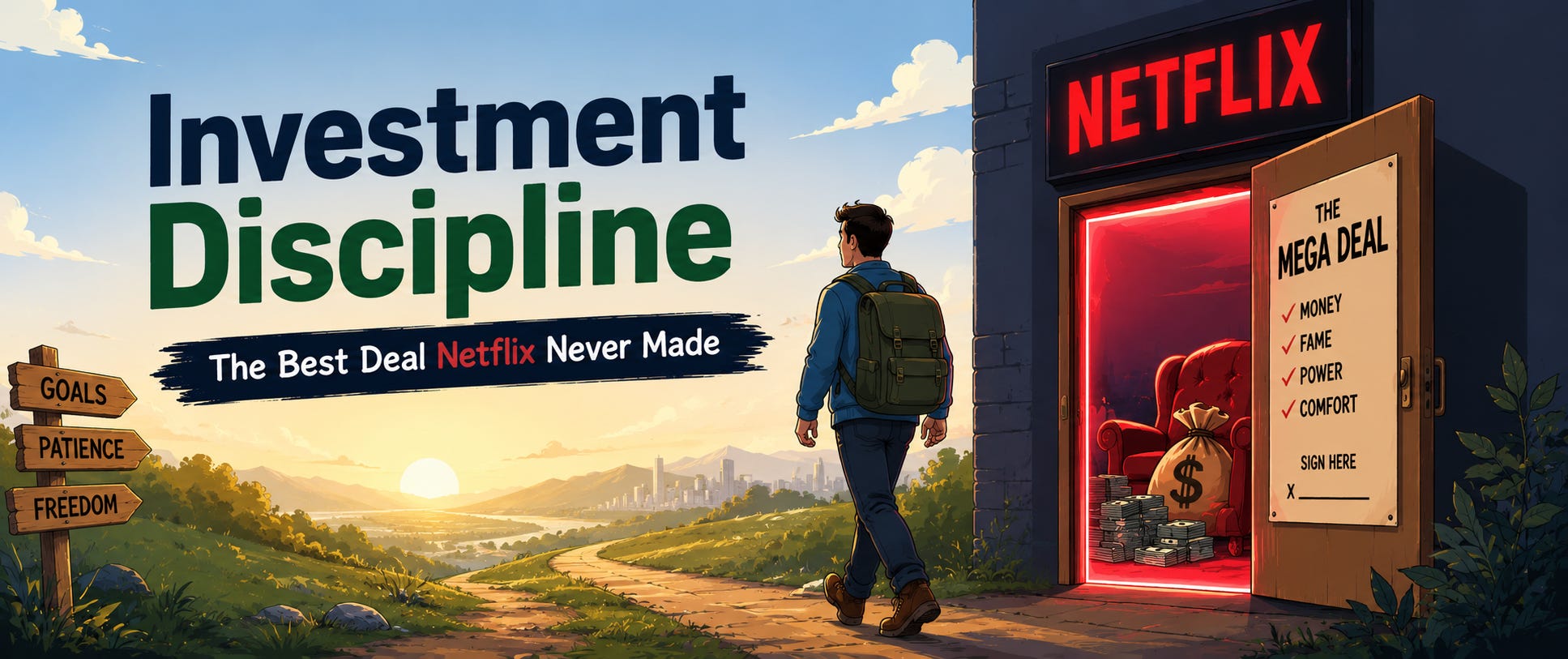
Earlier this quarter, Netflix reached into Warner Bros.’ cookie jar and pulled out a $2.8 billion termination fee after David Ellison Jr. (Oracle’s founder son) decided he wanted the deal more. Netflix had been in the running to acquire Paramount, and when the price crept beyond what made sense for the business and its shareholders, they walked.
It’s easy to gloss over this. In the day-to-day noise of earnings calls and market moves, a deal that didn’t happen barely registers.
Co-CEO Ted Sarandos put it plainly on the earnings call:
“The most important benefit of this entire exercise though was that we tested our investment discipline. And when the cost of this deal grew beyond the net value to our business and to our shareholders, we were willing to put emotion and ego aside and walk away.”
Ted Sarandos, Co-CEO, Netflix
Read that again. They framed a deal they didn’t do as a benefit. Not a loss. Not a near-miss. A test of discipline and they passed it.
In case you missed the last one...
Join us on Monday 25 May 2026 (7:30-915pm SGT), for our live Free webinar, where we cover:
* Our resilient investing strategy that we use in our public portfolio
* Stock Analysis: Will Visa be disrupted by AI?
Attendees will also get preview our new AI Powered Stock Market Simulator game where you’ll learn about your investing strengths and weakness.
👉🏼 Click here to reserve a spot. (LINK)
Why this is harder than it looks
Mergers and Acquisitions (M&A) processes have a gravitational pull. The longer you’re inside one, the due diligence, the lawyers, the internal champions, the press speculation, the harder it becomes to exit cleanly. Sunk costs start to feel like commitments.
Walking away can feel like failure, even when it’s the right call.
This isn’t unique to corporate boards. Every investor knows the feeling: you’ve spent weeks researching a stock, you’ve told your friends about it, you’ve watched it rally slightly, and now the valuation doesn’t quite work the way it did when you started.
Do you buy anyway? Most people do. The research itself becomes a reason to commit.
Netflix didn’t.
That matters.
Three lessons for investors
Lesson 1: Know your number before the process begins
Netflix clearly had a ceiling, a price at which the deal stopped making sense. They likely had it before Ellison entered the picture. The ability to walk away starts with having a predetermined exit point. As a portfolio investor, that means setting a target valuation before you buy, and revisiting it when the story changes, not after you’re emotionally committed to being right.
Lesson 2: Emotion is a cost, not just a feeling
Sarandos explicitly named ego as something that had to be set aside. That’s rare. Most executives and most investors don’t acknowledge that ego is a factor at all. But the desire to be seen as decisive, to “win” a deal or a trade, to not look like you hesitated these are real forces that distort judgment and cost money. Naming the emotion is the first step to not paying for it.
Lesson 3: Discipline compounds just like capital does
Netflix didn’t just avoid a bad deal. They built evidence, for themselves, for their board, for their shareholders, that their decision-making process works. In investing, a track record of disciplined passes is as valuable as a track record of good picks. Every time you avoid an overpriced entry or a panic-driven exit, you’re strengthening a muscle that pays dividends for decades.
What to watch for in management teams
When I evaluate companies, I pay close attention to how management talks about deals they didn’t do. A team that can articulate why they passed and frame that pass as a success, is a team that’s thinking clearly about capital allocation. That’s rare.
Most investor calls are about what was won. This one was about what was wisely left on the table.
I’ll take that signal seriously.
Only time will tell whether Netflix’s ultimate M&A strategy plays out, but the discipline on display here gives me real confidence in the people running the company. And in this environment, confidence in management is one of the most undervalued assets you can hold.
As always: the best investment you don’t make is still a good investment.
Disclaimer:
All information here is for educational purposes only. This is not financial advice. Please do your own research and speak with a licensed advisor before making any investment decisions. Past performance is not indicative of future returns. How we invest may not suit your investment goals and risk management profile.