


Dear Investors.
Zee here. I get asked this a lot: Is trading more better or worst? So I am gonna address this once for all.
My answer: Let me answer with a Meme
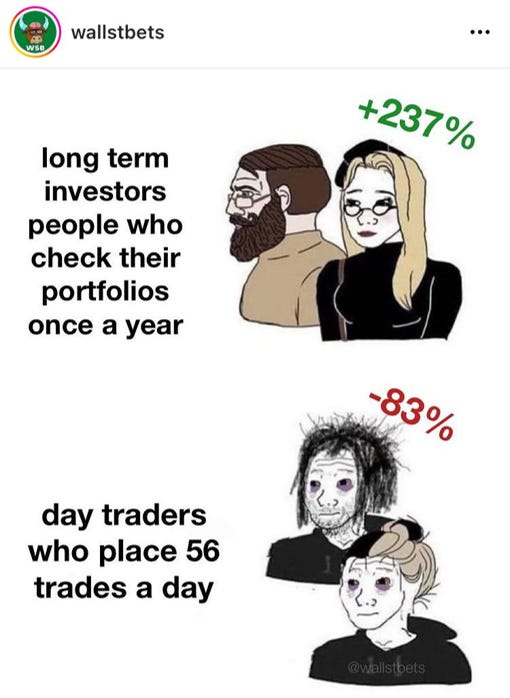
Most people assume investing rewards effort. Spend more hours in front of the charts, read more headlines, check your portfolio more often, surely that translates into better returns?
The data says otherwise. In investing, there’s a concept worth knowing: Return on Effort. It measures how much benefit you actually get for the time and energy you put in. And for most individual investors, that return curve bends the wrong way, the more you touch, the worse you tend to do.
Now Imagine two people starting out as investors on the same day, with the same amount of money.
The first sets an alarm before the market opens, watches every price tick, reads a dozen news alerts, and trades in and out of stocks throughout the day, chasing every swing. The second sets up a simple, diversified portfolio, automates a monthly contribution, and closes the laptop, checking in maybe twice a year.
10 years later, the second investor is very likely to be ahead. Not despite doing less, but because of it.
Here’s why, and what to do instead.
The Day Trading Trap
Day trading: buying and selling stocks within the same day, often multiple times a day, looks exciting. It promises fast profits for people willing to put in the hours watching screens and charts.
The numbers tell a different story.
Across large academic studies from markets in Brazil, Taiwan, and Europe, roughly 70% to 97% of day traders lose money, and only about 1% to 3% manage to stay consistently profitable over three or more years.
A well-known study of the Brazilian futures market tracked thousands of day traders and found that fewer than 1 in 100 were reliably profitable over time, most gave up their gains, and their capital, within months.
Why does something that demands so much effort produce such poor results? A few consistent patterns show up in the research:
Overtrading. Frequent buying and selling racks up fees and taxes that quietly eat into returns.
Poor risk management. New traders tend to hold on to losing positions too long and sell winning ones too early, the opposite of what works.
Emotional decision-making. Fear and excitement, not analysis, end up driving many trades.
Competing against professionals. Day traders are often trading against institutions with faster data, more capital, and algorithms built specifically to profit from short-term price swings.
In short, day trading asks for maximum effort and, for the vast majority of people, delivers negative returns.
It’s a near-perfect example of low, even negative Return on Effort.
Why Doing Less Often Works Better
Now compare that to long-term investing: buying a diversified set of investments, like a low-cost index fund tracking the S&P 500 and holding it for years, largely leaving it alone.
Historically, the US stock market has delivered average annual returns in the range of 9% to 10% before inflation over long stretches of time, despite containing plenty of scary drops along the way.
You don’t need to predict the next earnings report or read a single chart pattern to earn something close to that return.
You mostly need to stay invested and avoid interfering.
This is the heart of Return on Effort: a long-term investor who checks their portfolio a few times a year and consistently buys through market ups and downs will, on average, outperform a day trader who spends 40 hours a week glued to a screen.
Less effort, better outcome.
Why This Feels Counterintuitive
It’s natural to think that more work should produce more reward, that’s true in most careers. But markets don’t work like a job where hours in equal results out.
Prices already reflect a staggering amount of publicly available information, digested instantly by professional investors and algorithms.
An individual trying to out-analyze the market on any given day is competing against that machinery, not against a level playing field.
Meanwhile, the single biggest driver of long-term returns isn’t cleverness, it’s time in the market, compounding quietly in the background. Effort doesn’t accelerate compounding.
Patience does.
Real Examples: What the S&P 500 Actually Shows
It’s one thing to say “long-term investing works.” It’s more convincing to see it play out with real numbers.
#Example 1: The 2008 crash and recovery.
In 2008, the S&P 500 fell about 38% in a single year — one of the worst years in its history. Anyone who sold near the bottom locked in devastating losses.
But investors who held on saw the index rebound roughly 23% in 2009 alone, and it continued climbing from there.
A lump sum invested right before the crash took about five years to fully recover, painful, but not permanent, for those who stayed put.
#Example 2: The 20-year and 30-year averages.
Looking at the 20-year stretch from 2006 through 2025 — a period that includes the 2008 financial crisis — the S&P 500 still averaged about 11% per year. Stretch that out to 30 years (1996–2025), covering the dot-com bust, the 2008 crash, and the 2020 pandemic crash, and the average annual return comes to roughly 10.4%. Sitting through multiple “worst crash in a generation” headlines still produced a strong long-run average — simply because the good years outweighed the bad ones over time.
#Example 3: The danger of missing just a handful of days.
This is perhaps the most striking data point for anyone tempted to jump in and out of the market. J.P. Morgan Asset Management studied a $10,000 investment in the S&P 500 from 2005 through 2024. Staying fully invested the entire time turned that $10,000 into roughly $71,750 (a 10.4% annualized return).
But an investor who missed just the 10 single best days in the market during those 20 years, perhaps by moving to cash during scary headlines, ended up with only about $32,900, roughly half as much.
Miss the 60 best days, and the investment would have actually lost money. The catch: many of the market’s best days land within days of its worst ones, so trying to dodge the downturns often means missing the rebounds too.
#Example 4: The “average investor” gap.
Research firm Dalbar has tracked how actual retail investors perform compared to simply holding the S&P 500 index.
Over a 20-year period, the index returned about 7.2% annualized, while the average equity fund investor earned only about 5.29%, a gap caused largely by buying and selling at the wrong times.
Other long-running studies have found the gap to be even wider, with some estimating that the average investor captures well under half of the market’s actual return, purely due to behavior.
Put together, these examples tell a consistent story: the market has rewarded people who stayed invested through downturns far more than it has rewarded people who tried to dodge them.
Managing Yourself Matters More Than Managing Your Portfolio
If skill and effort aren’t the main ingredients, what is? Largely, it’s behavior:
Resisting the urge to react to every dip or rally
Sticking to a plan instead of chasing whatever is trending
Automating good habits, like regular contributions, so willpower isn’t required every month
Accepting “good enough” returns instead of chasing exceptional ones
Behavioral finance research consistently finds that investors who trade the least, and panic the least during downturns, tend to earn returns closest to what the market actually delivers.
The investors who underperform are usually the ones who do too much, buying high out of excitement, selling low out of fear.
Finding Your Own Return on Effort
None of this means all effort is wasted. Some activities genuinely pay off:
Setting up a diversified core and boost portfolio that matches your goals and risk tolerance
Finding fundamentally good stock, and then give it time to grow (like a plant)
Automating contributions so you invest consistently (i.e. DCA)
Reviewing your portfolio plan 1x or 2x a year — not once or twice a day
Beyond that, additional hours spent watching markets tend to produce diminishing, and often negative, returns.
The best approach is the one that fits your time, temperament, and lifestyle, not the one that demands the most hours.
If checking prices daily makes you anxious or tempts you to tinker, that’s a signal to simplify, not to work harder.
Sometimes, the highest Return on Effort in investing comes from barely investing any effort at all.
Disclaimer: All information here is for educational purposes only. This is not financial advice. Please do your own research and speak with a licensed advisor before making any investment decisions. Past performance is not indicative of future returns. How we invest may not suit your investment goals and risk management profile.