

Dear Investor,
Zee here. In this article, I wanted to introduce the concept of Charlie Munger’s inversion thinking.
During World War II, as a young Air Corps meteorologist, Munger applied this principle in a life-or-death situation. Instead of asking “How can I keep these pilots safe?” he inverted the question: “How can I kill these pilots?”
This reversed approach forced him to systematically identify the most dangerous flight conditions, treacherous routes, and hidden weather threats. By obsessively focusing on what could go wrong and then avoiding those scenarios, Munger achieved something remarkable: a 100% pilot safety record.
Years later, this same inverted thinking became the cornerstone of his investment philosophy alongside Warren Buffett at Berkshire Hathaway, helping them build one of the most successful investment records in history.
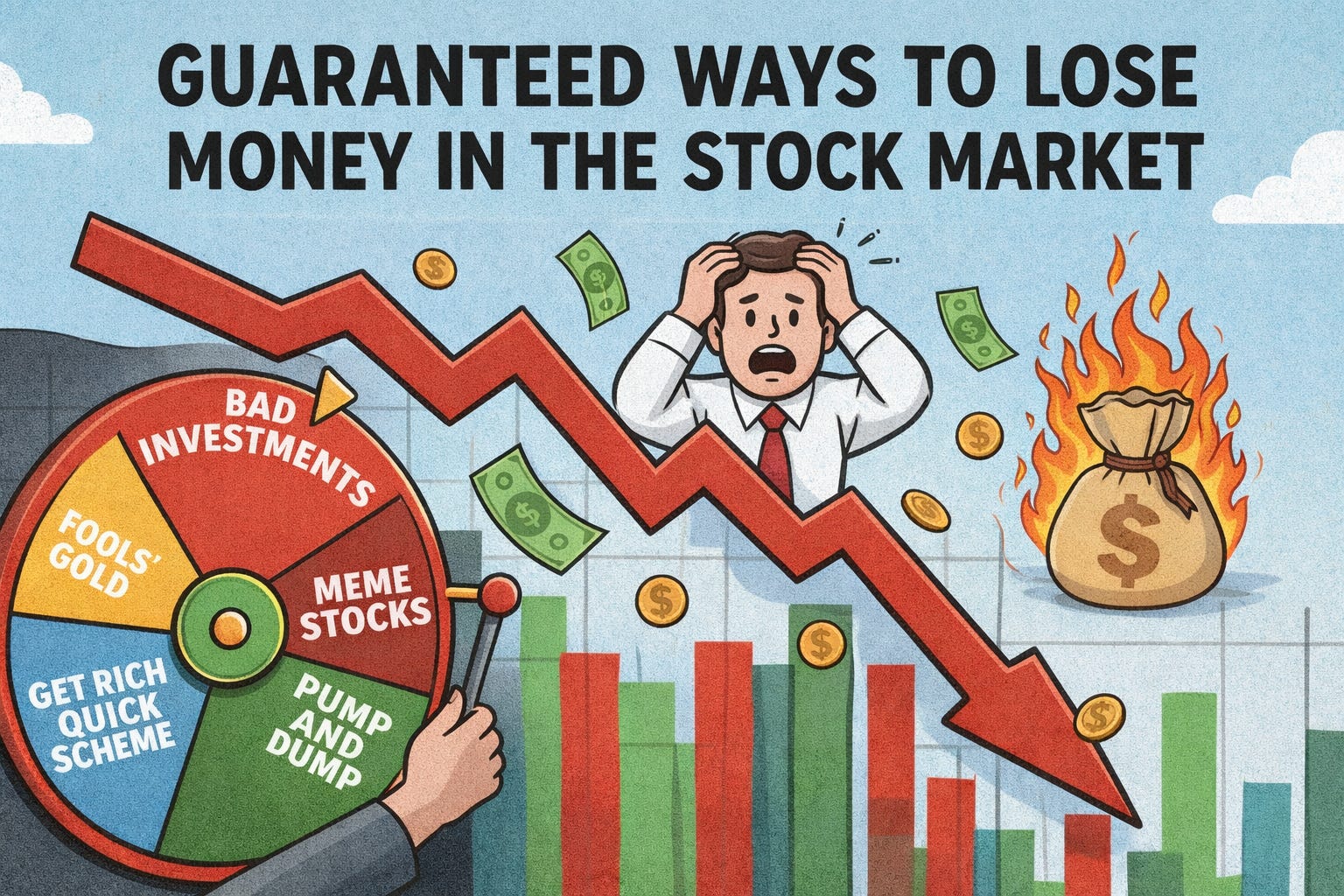
Today, I want to share 5 guaranteed ways to lose money in the stock market. Not because I want you to fail, but because once you understand these wealth-destroying behaviors, you can systematically avoid them and dramatically improve your investment outcomes.
Announcement:
Join us on Monday 9th Feb 2026, for our live Free webinar “One CEO, Two Universes: Tesla Today, SpaceX Tomorrow?”.
👉🏼 Click here to reserve a spot. (LINK)
#1 Invest in Businesses You Don’t Understand
The Mistake
Buying stocks in companies whose business models, products, competitive advantages, or financial statements you cannot explain in simple terms to someone else.
Why It’s Dangerous
When you don’t understand a business, you can’t distinguish between temporary setbacks and permanent impairment. You’ll panic during normal volatility and potentially hold during genuine crises. As Warren Buffett says, “Never invest in a business you cannot understand.”
Case Study: The Dot-Com Bubble
During 1999-2000, millions of investors poured money into internet companies they didn’t understand. Pets.com had a memorable sock puppet mascot but a business model that lost money on every sale. The company spent $300 on marketing to acquire each customer who made an average purchase of $25.
Investors who couldn’t read the financial statements or understand unit economics lost everything when the company collapsed nine months after its IPO. Meanwhile, investors who understood Amazon’s potential to revolutionize retail, despite temporary losses, held on and multiplied their wealth many times over.
The Solution
Develop a deep understanding before investing. Can you explain how the company makes money? What are its competitive advantages? Why do customers choose this company over competitors? If you can’t answer these questions confidently, move on to something you do understand.
#2 Chase the Hottest Stocks Everyone Is Talking About
The Mistake
Buying whatever stock is trending on social media, dominating headlines, or being discussed at parties and dinner tables.
Why It’s Dangerous
By the time everyone is talking about a stock, the price has usually already reflected the enthusiasm. You’re buying at peak excitement rather than at reasonable valuations. This is how you become the “greater fool” in an investment mania.
Case Study: GameStop and Meme Stocks (2021)
In January 2021, GameStop stock exploded from $20 to $483 in a matter of weeks, driven by social media hype and a short squeeze. Stories of overnight millionaires flooded Reddit and Twitter. Millions of new investors jumped in, not based on GameStop’s struggling retail business model, but because of FOMO (fear of missing out).
Those who bought at $400+ based on social media hype saw the stock collapse to $40 within weeks, losing 90% of their investment. Meanwhile, the underlying business still faced existential challenges from digital game distribution.
The investors who made money were either the early contrarians who bought below $20 or those disciplined enough to sell during the mania, not those who chased the headlines.
The Solution
Investigate stocks that aren’t making headlines. The best investments are often boring companies trading at reasonable prices, discovered through patient research rather than trending Twitter threads.
#3 Obsess Over Daily Price Movements
The Mistake
Checking your portfolio constantly, feeling euphoric when prices rise and distressed when they fall, making decisions based on short-term price action.
Why It’s Dangerous
Short-term price movements are primarily noise, reflecting the moment-to-moment negotiation between buyers and sellers rather than changes in business value. As our reference article emphasizes, these movements reflect “the current balance of power, sentiment, and urgency,” not the company’s actual worth.
Emotional reactions to volatility lead to buying high (when you feel excited) and selling low (when you feel fearful), the exact opposite of successful investing.
Case Study: Amazon’s Volatile Journey
Between 1997 and 2001, Amazon’s stock price fell 95% from its peak despite the company steadily executing its strategy to become the “everything store.” Investors who obsessed over daily price movements and couldn’t stomach the volatility sold at massive losses.
The company never stopped innovating. It expanded from books to electronics, built its fulfillment network, and laid the groundwork for AWS (Amazon Web Services). Those who focused on business fundamentals rather than stock price movements saw a $100 investment in 1997 grow to over $200,000 today.
During this period, there were hundreds of days with 5-10% swings. Each one felt significant in the moment. None mattered to the long-term outcome for patient investors focused on business quality.
The Solution
Check your portfolio infrequently. Focus on quarterly earnings reports and annual business results, not daily price changes. As the reference article notes, “short-term price movement is almost never about a company’s true worth.”
#4 Invest with Borrowed Money or Funds You’ll Need Soon
The Mistake
Using margin loans, credit cards, or home equity to invest, or investing money you’ll need for upcoming expenses in the next 3-5 years.
Why It’s Dangerous
Leverage magnifies both gains and losses. More critically, it creates forced selling scenarios. When markets drop and you face margin calls or unexpected expenses, you’re forced to sell at the worst possible time. The stock market’s greatest returns often come to those who can hold through downturns.
Case Study: Long-Term Capital Management (1998)
Long-Term Capital Management (LTCM) was a hedge fund run by Nobel Prize winners and renowned Wall Street traders. They used sophisticated mathematical models and massive leverage, borrowing $125 billion against just $4.8 billion in capital.
When Russian government bonds defaulted unexpectedly in 1998, LTCM’s highly leveraged positions collapsed. Despite brilliant minds and sound long-term strategies, they faced margin calls they couldn’t meet. The fund lost $4.6 billion in less than four months and required a Federal Reserve-orchestrated bailout to prevent systemic market chaos.
The irony? Many of LTCM’s underlying investment theses proved correct long-term. But leverage eliminated their ability to hold through temporary volatility.
The Solution
Only invest money you won’t need for at least 2-4 years. Never use borrowed money for stock investments. Build an emergency fund before investing. This gives you the psychological and financial cushion to hold quality investments through inevitable market downturns.
#5 Cut Your Flowers and Water Your Weeds
The Mistake
Selling your best-performing investments quickly to “lock in gains” while holding or adding to losing positions hoping they’ll recover, essentially cutting winners and averaging down on losers.
Why It’s Dangerous
This behavior is psychologically comfortable but financially destructive. Your winners are often winning for good reasons (strong business, competitive advantages, capable management), while your losers are often losing for equally valid reasons (flawed business model, increasing competition, poor execution).
Case Study: Holding Sears While Selling Amazon
Imagine an investor in 2007 who owned both Sears and Amazon. Sears was struggling, down 30% from purchase price, but it was a recognized brand with real estate assets. The investor kept averaging down, believing in a turnaround story.
Meanwhile, Amazon had doubled from the purchase price. Feeling nervous about giving back gains and not wanting to be “greedy,” the investor sold Amazon to lock in profits.
Over the next 15 years, Sears filed for bankruptcy in 2018, wiping out shareholders completely. Amazon increased over 3,000%. The investor’s natural psychological tendency to “take profits” and “give losers time to recover” led to catastrophic underperformance.
The painful truth: the investor’s decision to cut the flower (Amazon) and water the weed (Sears) turned what could have been life-changing wealth into a substantial loss.
The Solution
Regularly re-evaluate each position based on current fundamentals, not your purchase price. Be willing to let winners run much longer than feels comfortable. Be ruthless about cutting true losers where the business thesis has deteriorated. Your portfolio’s purchase prices are emotionally significant to you but completely irrelevant to future returns.
The Power of Inversion
Charlie Munger’s meteorological approach during World War II teaches us something profound about investing: sometimes the clearest path to success comes from mapping out failure and avoiding it.
You don’t need to be a genius to succeed in the stock market. You don’t need to predict the next Amazon or time the next crash. You simply need to systematically avoid the behaviors that destroy wealth.
As Munger himself later said about investing: “It is remarkable how much long-term advantage people like us have gotten by trying to be consistently not stupid, instead of trying to be very intelligent.”
Armed with this knowledge, here’s your action plan:
Only invest in businesses you deeply understand - If you can’t explain it simply, you don’t understand it well enough
Avoid the hot stocks - The best investments are usually found in overlooked places, not headline news
Stop checking prices daily - Focus on business performance, not market prices
Only use money you won’t need - Never invest with leverage or short-term funds
Let winners run, cut true losers - Overcome the natural tendency to do the opposite
By inverting the question from “How do I get rich?” to “How would I lose money?” and then systematically avoiding those behaviors, you’ve already positioned yourself ahead of the vast majority of investors.
Remember Charlie Munger’s pilots.
They didn’t fly into storms.
Neither should you.
All information here is for educational purposes only. This is not financial advice. Please do your own research and speak with a licensed advisor before making any investment decisions. Past performance is not indicative of future returns. How we invest may not suit your investment goals and risk management profile.
Loved the article, also a trader and it’s such a great take. I’ve just covered inversion from a general life perspective standpoint too. Read it if you want to and if you do, let me know your thoughts!
https://open.substack.com/pub/laxminarasimhanakshay/p/inversion-why-being-not-stupid-solved?r=3lgfj&utm_medium=ios&shareImageVariant=overlay