

Dear Investors.
Zee here. Not long ago, Robinhood was just the scrappy app that let you buy a slice of Apple stock without paying a broker’s fee. It ruffled feathers on Wall Street, got blamed for turning investing into a game, and became the symbol of a generation that wanted in on markets on their own terms.
Fast forward to today, and Robinhood is barely recognizable.
The platform now manages over $345 billion in customer assets, serves 27.4 million funded accounts, and has quietly built itself into something far more ambitious than a trading app. It offers banking, credit cards, AI-powered investment insights, cryptocurrency, and in its boldest move yet, lets everyday people bet real money on world events through prediction markets.
In the first quarter of 2026, Robinhood brought in $1.07 billion in revenue.
That’s not startup territory anymore. That’s a serious financial company.
Join us on Wednesday, 17 June 2026, from 7:30–9:15pm SGT for our free live webinar.
We’ll cover:
* The resilient investing strategy that generated 44% returns per year in our public portfolio over the past 3 years
* Stock Analysis: SpaceX IPO - Trap or Generational Opportunity?
Join us if you’re looking to learn a clear method to invest in stocks, ETFs, and options without needing to be a “finance person”.
👉🏼 Click here to reserve a spot. (LINK)
What Does Robinhood Actually Do?
Robinhood (ticker: HOOD) is a US-based financial super-app. It lets everyday people buy and sell stocks, ETFs, options, and cryptocurrencies, usually with zero trading commissions. Think of it as the app that made investing feel as easy as online shopping.
Today, it has grown far beyond simple stock trading, adding banking, AI tools, credit cards, and access to private company shares.
1. Revenue hit $1.07 billion, up 15% from last year
Robinhood’s Q1 2026 results showed steady growth, with revenues rising 15% year-over-year to reach $1.07 billion. More money is flowing in too, customers deposited a net $18 billion in the quarter, growing at a 22% annualised rate. That means people are not just opening accounts; they’re actively putting more money to work on the platform.
“Robinhood is increasingly positioned at the centre of our customers’ financial lives, just as we enter the early innings of the Great Wealth Transfer.” — CEO Vlad Tenev
The “Great Wealth Transfer” Tenev mentions refers to the trillions of dollars expected to pass from Baby Boomers to younger generations in the coming decades and Robinhood is betting it will be the platform those younger investors use.
2. Prediction markets are now Robinhood’s fastest-growing product ever.
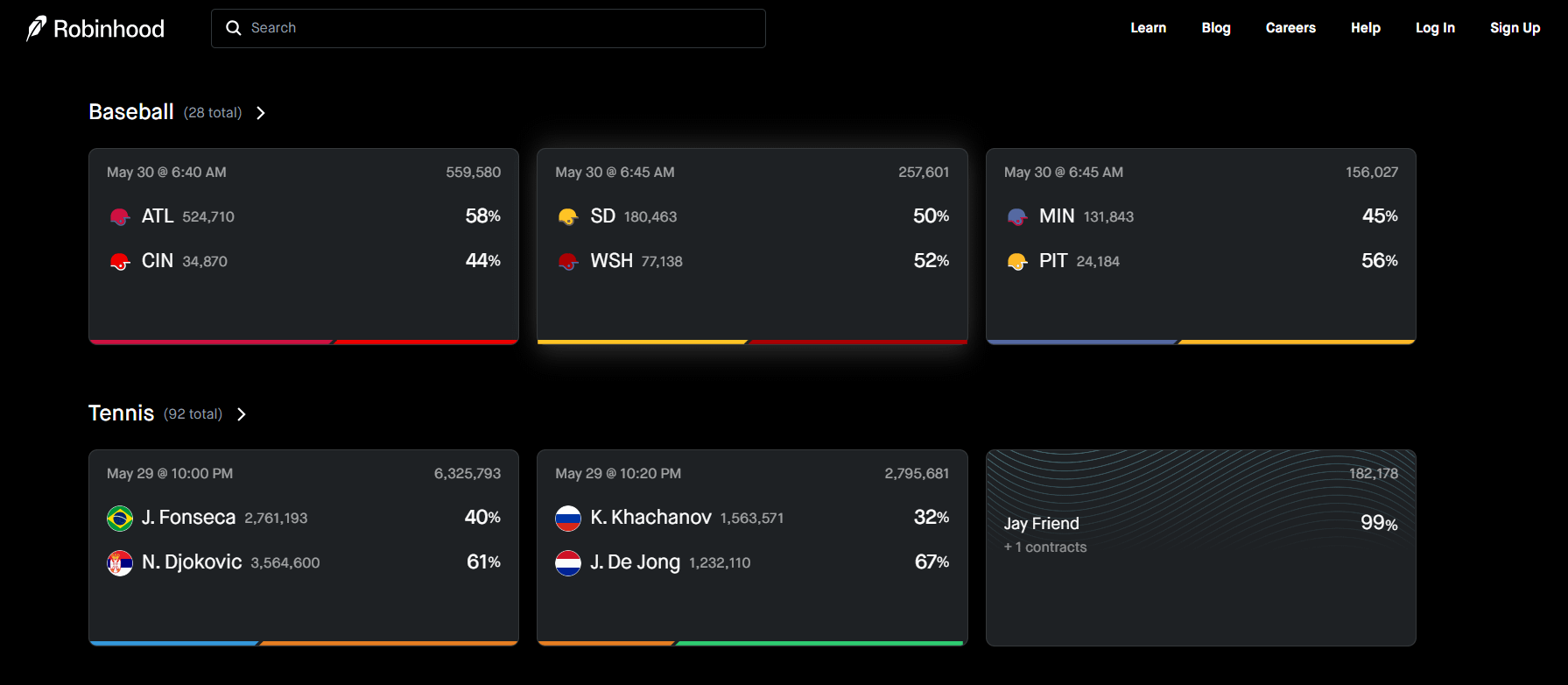
Prediction markets let you bet real money on the outcome of real-world events: elections, sports matches, economic data releases, and more. Robinhood launched the feature roughly a year ago, and the growth has been staggering: over 11 billion contracts traded by more than one million customers.
In Q1 2026, prediction markets hit record trading volumes on the platform. April tracked towards roughly $3 billion in volume, the second-best month ever. Robinhood has gone so far as to acquire a licensed exchange (MIAXdx) through a joint venture to build proper infrastructure for this business.
“Robinhood is the largest retail brokerage firm in prediction markets.” — CEO Vlad Tenev, Q1 2026 earnings call
What does this mean for you as an investor? It’s a brand-new revenue stream that doesn’t depend on stock market swings or crypto bull runs, which could make Robinhood’s earnings more stable over time.
3. Robinhood Cortex: AI that reads the market so you don’t have to
Robinhood launched Cortex, its AI-powered investing assistant, and it’s already being used by nearly one million customers. Cortex delivers personalized “Digests”, think of them as a morning briefing tailored to your specific portfolio, written by AI in plain language.
The latest version, called Cortex Assistant, is rolling out across the app and offers real-time, AI-powered insights as you trade. It can flag unusual moves in stocks you hold, summarise earnings reports, and help you understand what market news actually means for your investments.
For investors who don’t have hours to parse financial news daily, Cortex could become a genuinely useful edge.
It’s bundled with Robinhood Gold, the platform’s premium subscription that now has 4.3 million members, up 36% year-on-year.
4. A big crypto stumble but an even bigger crypto roadmap ahead
Here’s the not-so-rosy part: crypto revenue dropped sharply in Q1 2026 after a record-breaking Q4 2024 ($358 million). This disappointed investors and sent the stock price down about 13% after earnings. When people trade crypto less, Robinhood earns less in transaction fees.
But management isn’t pulling back. Instead, Robinhood has announced a sweeping 2026 crypto expansion including wider access across the US and Europe, new trading products, and even plans to build its own blockchain network (Layer 2).
They’ve also invested $75 million in OpenAI, signaling ambitions to be more than just a trading app.
5. SpaceX, private markets, and the democratization of exclusive investing
One of Robinhood’s boldest moves is giving everyday investors access to deals that were once reserved for the ultra-wealthy. The platform is positioning itself as a key gateway for retail investors to access high-profile private company shares, including pre-IPO exposure tied to the anticipated SpaceX listing.
Robinhood Banking has also quietly crossed $2 billion in deposits from over 125,000 customers. And the platform now offers credit cards, financial advisory services, and professionally managed portfolios.
In short, it’s building everything you’d need from a financial services company in one app.
Disclaimer:
All information here is for educational purposes only. This is not financial advice. Please do your own research and speak with a licensed advisor before making any investment decisions. Past performance is not indicative of future returns. How we invest may not suit your investment goals and risk management profile.