

Dear Investors.
Zee here. For over two decades, SpaceX remained one of the world’s most secretive and valuable private companies. Founded by Elon Musk in 2002, it revolutionized the space industry by developing reusable rockets and building a global satellite internet network.
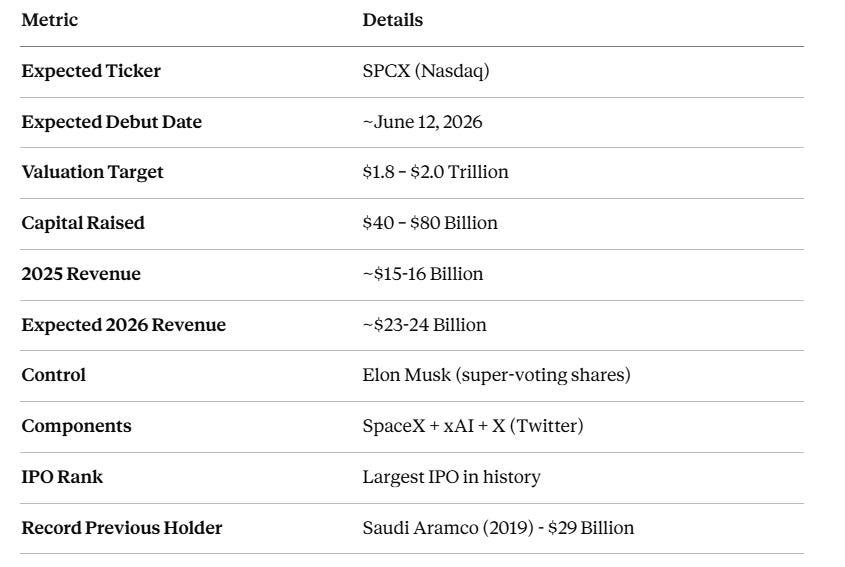
Yesterday, June 12th, 2026, SpaceX officially debut on the Nasdaq stock exchange under the ticker symbol SPCX.
This is not a typical tech IPO. Investors bought into something far more complex and ambitious: a vertically integrated powerhouse that combines space exploration, artificial intelligence development, and social media all under one roof.
Join us on Wednesday, 17 June 2026, from 7:30–9:15pm SGT for our free live webinar.
We’ll cover:
* The resilient investing strategy that generated 44% returns per year in our public portfolio over the past 3 years
* Stock Analysis: SpaceX IPO - Trap or Generational Opportunity?
Join us if you’re looking to learn a clear method to invest in stocks, ETFs, and options without needing to be a “finance person”.
👉🏼 Click here to reserve a spot. (LINK)
WHAT IS SPACE X?
Before diving into the key IPO facts, it’s important to understand what SpaceX actually is today, because it’s more than just rockets.
SpaceX (The Core Business)
The original company, founded in 2002, builds and launches rockets. Its workhorse vehicle, the Falcon 9, has become the world’s most frequently launched orbital rocket. SpaceX also operates Starlink, a satellite internet network with thousands of satellites in orbit, bringing broadband to remote areas worldwide. For governments and private companies, SpaceX launches cargo missions, crewed spacecraft, and satellites. This division generated approximately $15-16 billion in revenue in 2025 and is expected to hit nearly $24 billion in 2026, making it the dominant revenue driver.
xAI (The AI Division)
In February 2026, Musk merged his artificial intelligence company xAI into SpaceX. xAI developed Grok, an AI chatbot designed to compete with ChatGPT and other large language models. This division also works on AI data center infrastructure and computing capabilities that could eventually power space-based operations. While smaller today, xAI represents Musk’s vision of integrating AI directly with SpaceX’s satellite and launch capabilities.
X (The Social Media Component)
Here’s the controversial part: xAI owns X (formerly Twitter), the social media platform Musk acquired in 2022. When you buy SpaceX stock, you’re also buying a stake in X. This platform has seen advertising revenue decline significantly while the company invests heavily in new features and AI integration. This is a major point of debate among potential investors.
The Structure
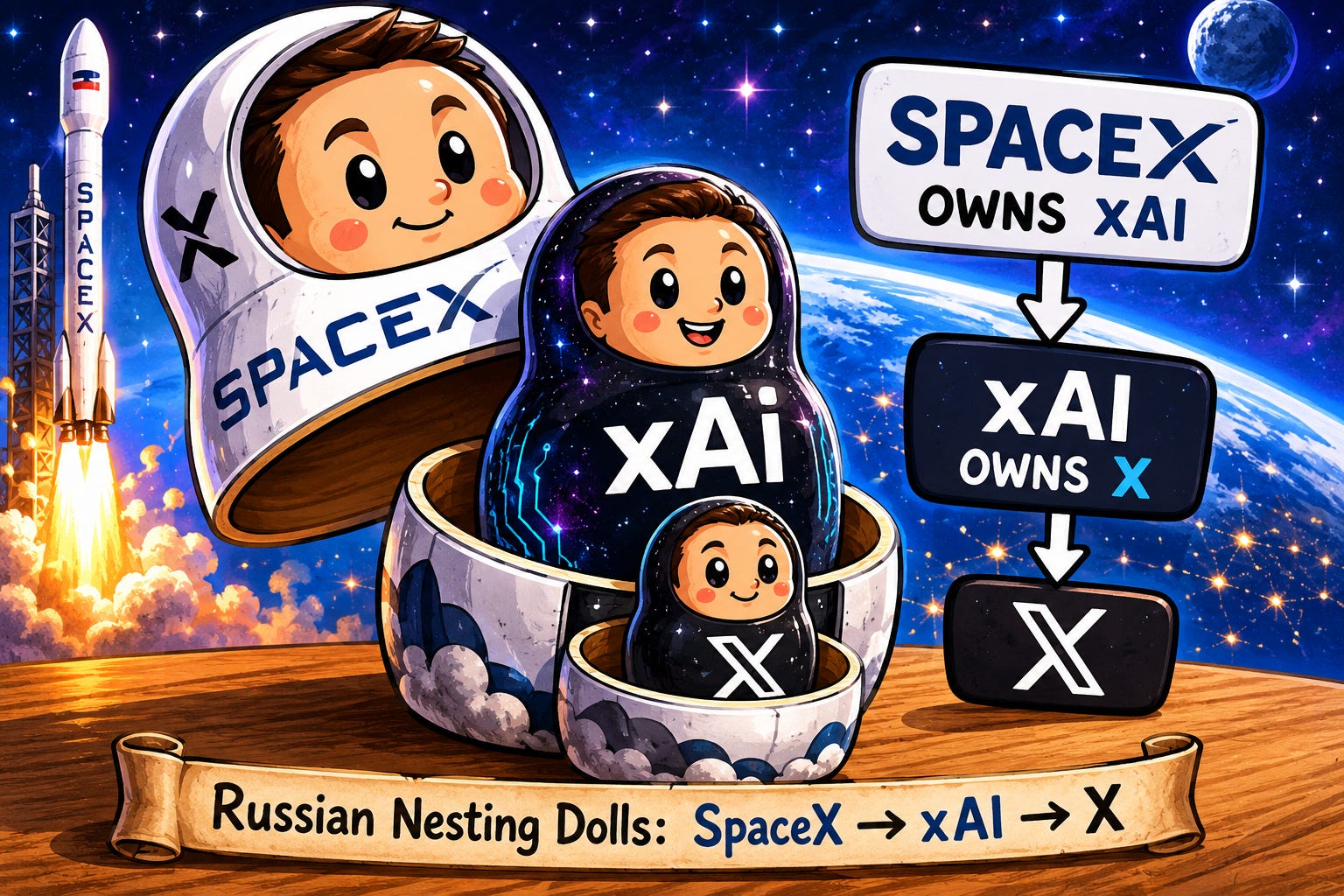
Think of it like Russian nesting dolls: SpaceX owns xAI, and xAI owns X. This integrated structure was finalized in February 2026 with a combined valuation of $1.25 trillion. While some investors see this as creating powerful synergies, others worry about the complexity and the inclusion of a struggling social media platform.
1. THE VALUATION IS HISTORIC AND EXTREME
SpaceX’s IPO is targeting a valuation of $1.8 to $2 trillion, with the company aiming to raise between $40 billion and $80 billion. To put this in perspective, this would be 3x larger than Saudi Aramco’s 2019 IPO, which previously held the record at $29 billion raised.
At a $1.8 trillion valuation, SpaceX would be valued at roughly 100-125 times its estimated 2025 revenue of $15-16 billion. By comparison, Apple trades at around 30-40 times revenue, and Amazon at roughly 2-3 times. Even if you believe in SpaceX’s growth story, this valuation assumes enormous future profits. Many analysts warn that even strong growth may not justify these multiples for years or decades.
You’re paying a premium price based on future potential, not current earnings.
2. ELON MUSK KEEPS CONTROL WHICH IS A DOUBLE-EDGED SWORD
The IPO filing reveals that SpaceX will be a “controlled company,” meaning Elon Musk will maintain effective control through super-voting shares and other governance mechanisms even after going public.
The upside: A visionary founder with clear control can make bold, long-term decisions without constantly worrying about quarterly earnings. Musk has repeatedly made unconventional bets that paid off, from the Falcon 9 landing innovation to Starlink’s rapid expansion.
The downside: Shareholders have limited ability to influence major decisions. If Musk makes a strategic move you disagree with, like redirecting resources to xAI or X, you have limited recourse. There’s also the risk that his attention gets divided across too many ventures.
You’re not just buying a company; you’re buying into Elon Musk’s vision, for better or worse.
3. YOU’RE FORCED TO BUY TWITTER
Let’s be direct: if you buy SpaceX stock, you own a piece of X (formerly Twitter). There’s no way to separate them.
X has been losing money significantly. Advertising revenue fell by $100 million in the first quarter of 2026 alone after the company overhauled its ad technology. While xAI itself is a money-losing operation ($2.5 billion in losses over six months on minimal revenue), the hope is that AI integration will eventually make both entities profitable.
Some investors are excited about owning a stake in Musk’s AI ambitions and the controversial but influential social media platform. Others see it as an unnecessary anchor dragging down the otherwise promising SpaceX business. You don’t get to choose, it comes as a package deal.
Before buying SPCX shares, you need to be comfortable owning Twitter. If you’re not, this IPO might not be right for you.
4. THE IPO TIMING MATTERS
Historical pattern: Most IPOs see prices spike on day one as retail investors rush in, then pull back significantly within weeks or months. The record-setting IPO price is often not the best entry point. Companies like Alibaba, Facebook, and Snap all saw significant declines within 6-12 months of their debuts, despite strong businesses.
The 6-month rule: Professional investors often wait at least six months after an IPO to evaluate whether the stock settles at a rational valuation. Early investors are betting on momentum and hype, not fundamentals.
There’s no rush. If SpaceX is a good investment at $1.8 trillion today, it will still be a good investment next year, potentially at a lower price.
5. REVENUE GROWTH IS IMPRESSIVE, BUT PROFITABILITY QUESTIONS LOOM
Here’s the bullish case: SpaceX generated roughly $15-16 billion in revenue in 2025 and is expected to reach $23-24 billion in 2026. Some reports suggest SpaceX achieved $8 billion in profit in 2025, which would be an impressive 50%+ margin.
The challenges:
Starlink is capital-intensive: While Starlink is the fastest-growing segment, it requires constant investment in satellites and ground infrastructure
Government contracts are unpredictable: SpaceX relies heavily on NASA and Department of Defense contracts, which can be subject to policy changes
International competition is heating up: European and Chinese space programs are investing heavily in reusable rockets and satellite internet
xAI and X are money-losing: These subsidiaries are currently drains on cash flow, though they could theoretically become profitable with AI monetization
The core SpaceX business looks solid, but the overall company’s profitability remains uncertain once you factor in the losses at xAI and X.
THE BOTTOM LINE
SpaceX’s IPO represents something genuinely historic: a chance to own a stake in a company reshaping space exploration, satellite internet, and AI development.
The valuation is audacious, the business fundamentals are solid (for SpaceX proper), and Elon Musk’s control ensures bold strategic decisions.
But it’s also expensive, complex, includes Twitter as an unwanted package, and assumes enormous future profitability.
For conservative investors, waiting 6-12 months for the stock to settle might make more sense than buying at the opening bell.
If you’re uncertain, there’s nothing wrong with watching from the sidelines at least for now.
Disclaimer:
All information here is for educational purposes only. This is not financial advice. Please do your own research and speak with a licensed advisor before making any investment decisions. Past performance is not indicative of future returns. How we invest may not suit your investment goals and risk management profile.