


Dear Investor.
Zee here. Every time someone taps a card, clicks “pay now,” or sends money across borders, there’s a good chance Visa had something to do with it. With over $4.5 trillion processed in a single quarter, Visa isn’t just a payments company, it’s the invisible infrastructure beneath the global economy.
But Visa isn’t standing still.
Beneath the steady earnings beats and reliable dividend, something bigger is happening: the company is quietly repositioning itself for a world where AI agents do your shopping, digital dollars move across borders instantly, and the very definition of a “payment” is changing.
Join us on Wednesday 6 May 2026 (7:30-915pm SG Time), for our live Free webinar, where we cover:
* Our resilient investing strategy that we use in our public portfolio
* Stock Analysis: Will Visa be disrupted by AI?
Attendees will also get preview our new AI Powered Stock Market Simulator game where you’ll learn about your investing strengths and weakness.
👉🏼 Click here to reserve a spot. (LINK)
First, What Does Visa Actually Do?
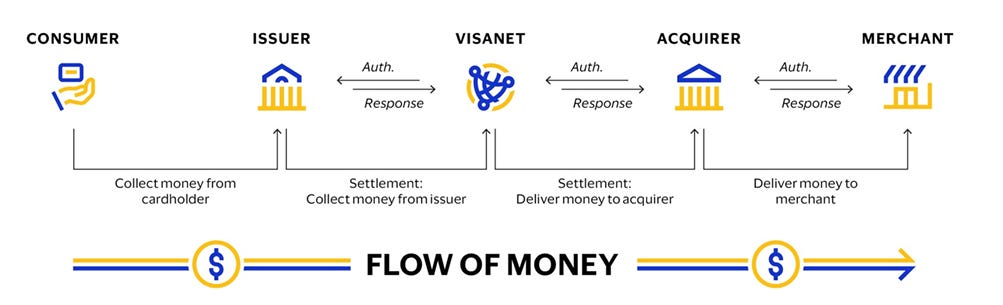
Think of Visa as the world’s most important toll road, but for money.
When you tap your card at a coffee cafe, Visa doesn’t give you the money or lend it to you. What it does is act as the trusted “middleman” that connects your bank to the merchant’s bank in a fraction of a second, making sure the transaction is secure, fast, and reliable. For every transaction that passes through its network, Visa earns a small fee.
Multiply that by trillions of dollars in purchases every year across more than 200 countries, and you start to see why Visa is one of the most profitable businesses on earth.
Visa doesn’t take on credit risk (that’s the bank’s job). It just owns the rails that money travels on, and those rails are used billions of times a day.
1. The Growing Business
Visa’s most recent quarterly results (Q1 of its fiscal year 2026, covering October–December 2025) were outstanding.
Revenue hit $10.9 billion, up 15% from the same period a year ago and that beat what Wall Street analysts had expected. Earnings per share came in at $3.17, also ahead of forecasts.
Payment volumes, the total dollar value of all transactions on Visa’s network, grew 8% to roughly $4.5 trillion in just one quarter.
What’s driving this? Strong consumer spending, a busy holiday shopping season, and surging cross-border transactions (people travelling and spending abroad), which grew 11%.
The CEO described Visa as a “payments hyperscaler”, a company whose infrastructure scales effortlessly as more spending flows through it. Management expects “low-double-digit” growth to continue for the rest of the year.
For investors, this is a business that consistently grows, beats expectations, and generates enormous amounts of cash.
2. Visa Is Betting Big on AI-Powered Shopping
Here’s the most exciting development for the future: Visa is positioning itself at the centre of “agentic commerce”, a world where AI assistants don’t just recommend products, but actually buy things on your behalf.
Imagine telling your AI assistant, “Book me a flight and hotel for my Tokyo trip,” and it just handles everything, finding, comparing, and paying, without you lifting a finger. For that to work safely, there needs to be a trusted payment layer. That’s where Visa comes in.
Visa has launched its Intelligent Commerce platform and a Trusted Agent Protocol, essentially a set of rules and tools that allow AI agents to make payments securely on behalf of consumers at over 150 million Visa-accepting merchants worldwide.
This week, Visa unveiled Intelligent Commerce Connect, a new solution helping businesses plug into AI-powered commerce.
Visa research shows that 47% of US shoppers already use AI tools for at least one shopping task. The company believes that by the 2026 holiday season, millions of consumers will use AI agents to complete purchases.
By building the infrastructure now, Visa is ensuring it remains the trusted payment layer, even as how we shop is fundamentally transformed.
3. Stablecoins: Visa Is Already Ahead of the Curve
You may have heard of “stablecoins”, these are digital currencies pegged to real-world currencies like the US dollar. Unlike Bitcoin, they don’t fluctuate wildly in value. Think of them as digital dollars that can move instantly across the internet.
Visa has been quietly building a major position here. It already supports over 130 stablecoin-linked card programmes in more than 50 countries, and its stablecoin settlement volume has reached a run rate of $4.6 billion globally. In simple terms: real money is already flowing through Visa’s stablecoin infrastructure.
Why does this matter for investors?
Stablecoins could eventually allow faster, cheaper international payments and Visa wants to be the trusted bridge between the old financial world and this new one, rather than be disrupted by it. As stablecoin regulations become clearer (especially in markets like Singapore, Hong Kong, and Japan), Visa’s early investments could translate into significant new revenue streams.
4. A Long Legal Saga Is Finally Clearing Up
For over 20 years, Visa has been tangled in lawsuits from merchants over interchange fees, the small percentage businesses pay every time a customer swipes a card. Merchants argued these fees were unfairly high and anti-competitive.
The good news: this legal overhang is substantially resolving. Visa have recently settled the final interchange fee claims from about 65 major retailers in a New York case, including big names like Nike, Dick’s Sporting Goods, Crate & Barrel, and Amtrak.
In total, Visa has paid out $4.2 billion from its litigation escrow between 2023 and early 2026.
A broader class-action settlement covering millions of merchants is still working through court approval, and a separate injunctive case continues in Brooklyn. There’s also a litigation provision of $707 million that hit Visa’s earnings this quarter. But the direction of travel is clear, the biggest legal clouds are lifting, reducing one of the key risks that has hung over the stock for years.
5. Earnings Update: Visa reported its fiscal Q2 2026 results on April 28, 2026
Visa posted $11.2 billion in quarterly revenue, up 17% from a year ago. The growth was broad-based, driven by more people spending on cards, more international trips, and more online purchases. When a company of Visa's size grows this quickly, it signals genuine demand momentum rather than accounting tricks.
CEO Ryan McInerney devoted significant time on the earnings call to what the company calls "agentic commerce", which are AI assistants that shop and pay on your behalf, without you lifting a finger. Visa has already completed hundreds of secure AI-initiated transactions with partners and launched a "Trusted Agent Protocol" to help merchants verify whether it's a legitimate AI agent or a malicious bot making a purchase.
Visa’s management sees this as a structural growth driver: more AI agents buying things means more transactions, more microtransactions, and more fees flowing through Visa's network.
Disclaimer:
All information here is for educational purposes only. This is not financial advice. Please do your own research and speak with a licensed advisor before making any investment decisions. Past performance is not indicative of future returns. How we invest may not suit your investment goals and risk management profile.