


Dear Investors.
Zee here. I decided to write this article urgently to allay 2 irrational fears:
(i) That a Democratic Congress, with a Republican President can affect the markets
(ii) That a Democratic Congress can stop US Data centers build out.
On November 3, US voters in a number of states did something the AI industry had mostly avoided thinking about: they treated data centers as a local nuisance to be voted on, not an inevitable feature of progress.
At the same time, the companies building them are signing financial commitments that stretch far beyond the next election cycle. Those two facts are on a collision course, and the collision is the real story behind the market’s nervousness.
Let me address them below…
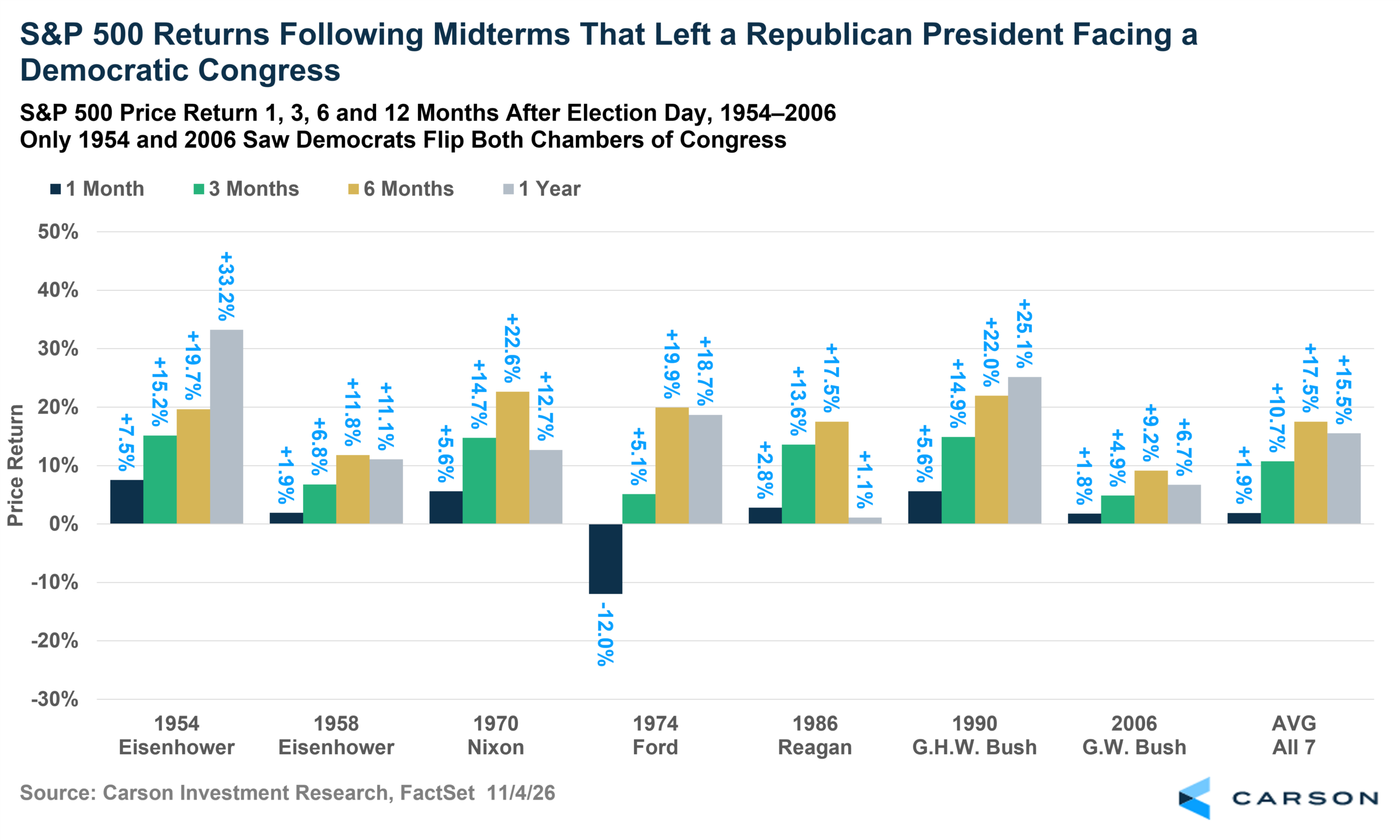
Historically, the S&P 500 has delivered an average gain of 15.5% in the 12 months following a midterm election that resulted in a Republican President facing a Democratic-controlled Congress.
This is not an unusual political outcome, and history suggests that markets can perform well even under a divided government.
Next, the AI Builout and voters.
The election results have raised significant concerns about the outlook for technology stocks, particularly regarding AI-related capital expenditure (capex), with data centre expansion being a key area of focus.
It is important to remember that this capex spending eventually flows through the technology ecosystem and translates into corporate revenues and earnings. Any slowdown in spending, therefore, could have a knock-on effect on earnings growth across the sector.
The House and Senate alone cannot halt the data centre expansion. Much of the decision-making authority rests with state governors and local authorities, which have significant influence over permitting, zoning, land use and infrastructure approvals.
This is why Democrat Gina Hinojosa’s election as Texas Governor has implications for markets, particularly given Texas’s importance to the US data centre industry. That said, she cannot unilaterally stop the expansion, and it remains unclear whether doing so is even her intention.
It is also worth noting that outgoing Republican Governor Greg Abbott had already introduced a moratorium on new data centres. The key question, therefore, is whether the incoming administration will maintain, modify or reverse the existing restrictions, and what that could mean for the pace of AI infrastructure investment in Texas.
Why voters oppose datacenters?
The national polling points the same way. Gallup found 71% of Americans opposed to a data center near them, according to reporting from Pluribus News. A Reuters/Ipsos poll in June found 57% opposed, including two-thirds of Democrats and half of Republicans.
The stated reasons are mundane. Electricity bills, water use, noise, land, and the small number of permanent jobs a finished facility creates come up again and again. In a UMBC poll of Maryland likely voters, 80% expected a negative effect on household electricity costs.
One finding suggests the opposition is conditional rather than absolute. In a May Embold Research poll, the share of voters expecting higher power prices fell from 73% to 46% when the hypothetical data center generated part of its own power from on-site renewables. People may be objecting less to the buildings than to the idea of paying for the grid they require.
Growing opposition to data centres does not necessarily mean the buildout will come to an end. However, it could make expansion considerably more expensive. Even delays can translate into higher costs, while many AI companies are already committed to long-term contracts that may be difficult or costly to exit.
AI CAPEX is indeed rising
The concern is that this is no longer a small corner of the economy or financial markets.
AI infrastructure investment has become a massive component of corporate capital expenditure, with significant implications for technology earnings, valuations and the broader market. The sheer scale of this investment makes any slowdown or disruption potentially consequential.
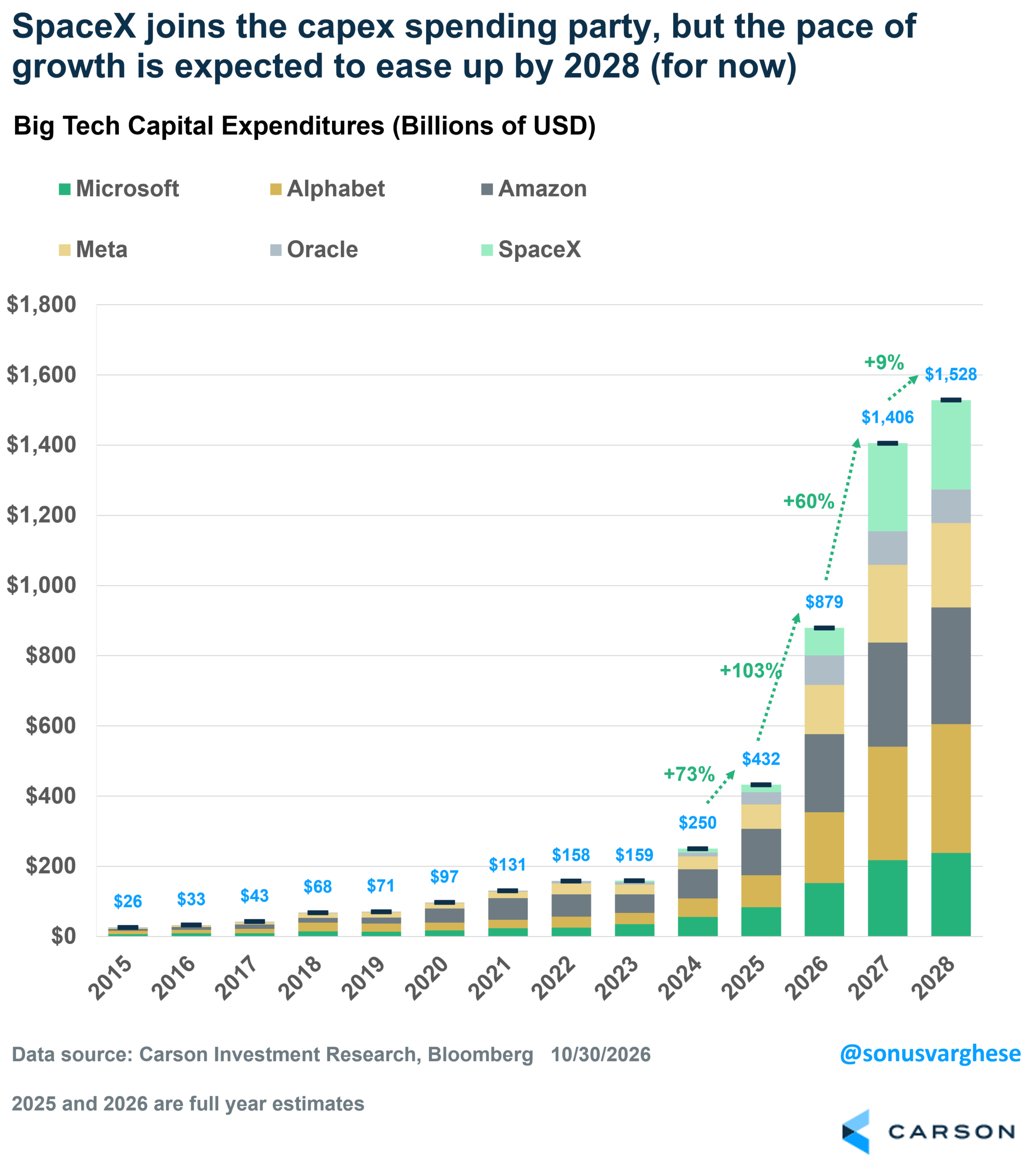
Including SpaceX, combined capex looks like this:
2025: $432 billion (+73% y/y)
2026: $879 billion (+103%)
2027: $1.41 trillion (+60%), about 4.0% of GDP
2028: $1.53 trillion (+9%)
The worry about AI CAPEX spending translating into actual earnings should be more concerning that voters.
Concluding
The mid-terms results may not change the AI buildup much because:
The votes are local. Each measure covers one town or county. If one place says no, developers can build somewhere else or overseas.
A delay is not a stop. Economists quoted by CBS say moratoriums may delay construction but won’t torpedo AI capital spending. Projects take longer, but the money still gets spent.
Much of the spending is already locked in. Carson says many AI firms are locked into long-term contracts they can’t get out of. Reuters also reported that capacity under construction was up 48% nationally.
Voters’ main worry can be fixed. People mostly fear higher electricity bills. If data centers pay for the grid or generate their own power, much of the opposition could fade.
So the likely outcome is a slower and more expensive buildout, not a stopped one.
Disclaimer:
All information here is for educational purposes only. This is not financial advice. Please do your own research and speak with a licensed advisor before making any investment decisions. Past performance is not indicative of future returns. How we invest may not suit your investment goals and risk management profile.