

Dear Investor,
Zee here. You’ve thought about investing before. Maybe you’ve researched stocks, watched YouTube videos, or even opened a brokerage account. But something stopped you from pulling the trigger.
“Will I lose money trading?”
This question haunts almost every investor. It’s the fear that keeps savings accounts full and investment portfolios empty.
And honestly? I can’t promise you won’t lose money.
Nobody can.
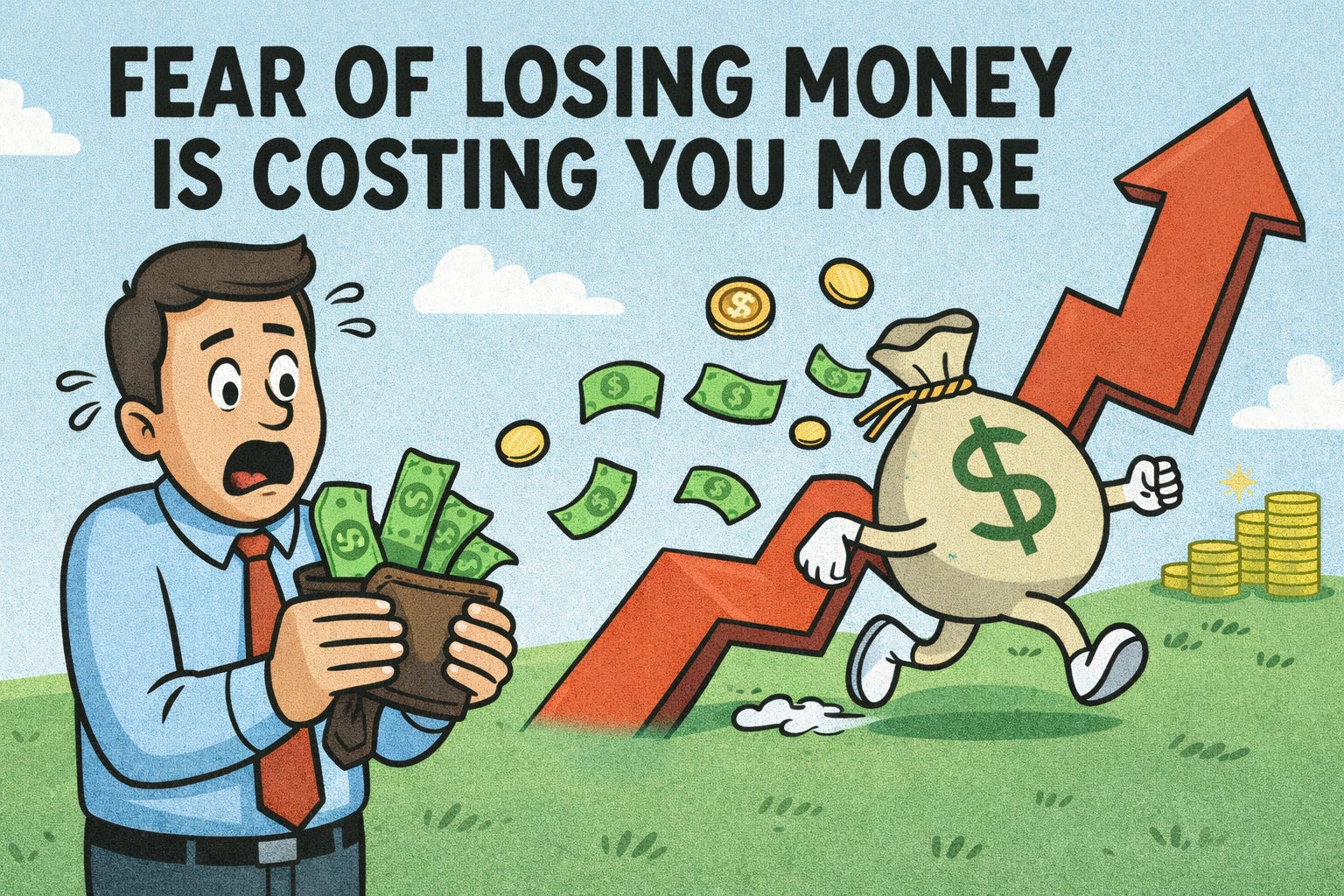
But here’s what I can tell you: your money will never work for you if it stays on the sidelines.
In this New Year’s post, I want to share the lessons about risk that nobody talks about, the ones that changed how I think about investing, failure, and what it really means to build wealth.
Announcement:
Join us on Wednesday 7th Jan 2026, for our live Free webinar “ETF vs Funds sold by Insurance Companies, which is better?”.
👉🏼 Click here to reserve a spot. (LINK)
Two Types of Losses
When most people think about investing, they immediately picture the nightmare scenario: watching their hard-earned money disappear in a market crash. It’s vivid, it’s scary, and it feels catastrophic.
But here’s the truth that took me years to understand: losses don’t just happen when you take risks. They happen when you don’t take risks too.
The difference? One type of loss is visible and painful. The other is silent and invisible.
(1) The Visible Loss: Money on the Table
When you invest and the stock drops, you see it immediately. Your account balance turns red. The number goes down. It feels terrible. This is the loss everyone fears.
Let’s say you invest $1,000 in a stock and it drops 10% in the first month. You’ve lost $100. You can see it. You can feel it. Your brain screams, “I told you this was a bad idea!”
(2) The Invisible Loss: The Opportunity Cost
But what about the loss you don’t see?
What if you keep that $1,000 in a savings account earning 0.5% interest while inflation runs at 3%? You’re losing 2.5% in purchasing power every year. That’s $25 annually, and it compounds.
Over ten years, that $1,000 sitting “safely” in your account becomes worth only about $780 in today’s dollars. You didn’t lose money on paper, but you lost the ability to buy the same things.
Even worse, imagine if that $1,000, invested in a diversified index portfolio averaging 8% annual returns, could have grown to $2,159 over the same period. By playing it safe, you didn’t just lose $25 a year to inflation. You lost the opportunity to potentially more than double your money.
That’s opportunity cost. And it’s the most expensive type of loss because you never see the bill.
Case Study #1: Sarah’s “Safe” Strategy That Cost Her $250,000
Let me tell you about Sarah. She’s a 35-year-old marketing manager who has been saving diligently for ten years. Every month, $500 goes straight into her savings account. She’s proud of her discipline.
After ten years, Sarah has saved $60,000. Not bad, right?
But here’s what Sarah doesn’t realize: if she had invested that same $500 monthly into a simple index fund tracking the S&P 500, which has historically returned about 10% annually, she would have approximately $102,000 instead.
That’s a $42,000 difference from just ten years of playing it safe.
Now, let’s fast forward. If Sarah continues this pattern for another 20 years until retirement at 65:
Savings account scenario: $240,000 saved (not accounting for inflation’s erosion)
Investment scenario: $490,000 (with historical market returns)
By avoiding the “risk” of investing, Sarah’s invisible loss totals around $250,000 in potential wealth. That’s not pocket change. That’s a house down payment, early retirement, or financial freedom.
The painful irony? Sarah thought she was protecting her money. Instead, she was guaranteeing she’d have less of it.
The Real Secret: Losses Are Just Tuition
Here’s where everything shifts.
When you start investing, you will make mistakes. You might buy a stock that drops 20%. You might panic sell during a dip. You might invest in a company that goes bankrupt.
But every loss teaches you what winning requires.
Think about it this way: losses are just tuition in the school of risk. They’re not failures. They’re lessons you paid for, and you’d better make sure you learn from them.
The first time I lost money on a trade back in 2007, I thought the world was ending. I had invested $2,000 in a hot stock everyone was raving about. Within two months, it had dropped 30%. I lost $600.
I felt stupid. I felt like maybe investing wasn’t for me. I questioned everything.
But that loss taught me three invaluable lessons:
Never invest based on hype alone – I hadn’t done my own research or proper fundamental analysis. I just followed the crowd.
Diversification matters – Having all my eggs in one basket amplified the pain.
Emotions are dangerous – My panic almost made me sell at the bottom. Instead, I held on, and the stock eventually recovered.
That $600 loss was worth every penny because it transformed how I approach investing. It was expensive education, but it was education I couldn’t get anywhere else.
Case Study #2: Michael’s $1,000 Experiment That Changed His Life
Michael was a 28-year-old teacher who had never invested a dollar in his life. Like most people, he was terrified of losing money.
But one day, he decided to run an experiment. He took $1,000, money he could afford to lose, and invested it in three different stocks after doing basic research. He told himself: “This is my tuition. I’m paying to learn.”
Here’s what happened:
Stock #1: A healthcare company he believed in. It gained 15% over six months. He made $50.
Stock #2: A retail company that was struggling. It dropped 25%. He lost $83.
Stock #3: A tech startup with strong fundamentals. It surged 40%. He made $133.
After six months, Michael’s $1,000 had grown to $1,100. Not life-changing money, but that wasn’t the point.
The point was what he learned:
He discovered he could read financial statements and understand what they meant.
He learned to handle the emotional rollercoaster of watching prices fluctuate.
He realized that losing money on one investment didn’t mean he was a failure.
Most importantly, he learned that he was capable of investing successfully.
Five years later, Michael has a portfolio worth $45,000. He still makes mistakes, but each one teaches him something new. And he’s no longer afraid.
That initial $1,000 experiment? Best money he ever spent.
Case Study #3: The Power of Time and Patience
Let me introduce you to Jennifer, a 40-year-old nurse who started investing with just $5,000 in 2010.
Jennifer didn’t know much about investing, so she kept it simple. She invested her $5,000 in an S&P 500 index fund and made a promise to herself: don’t touch it for ten years, no matter what happens.
Here’s what Jennifer experienced during those ten years:
2011: Market volatility from the European debt crisis. Her portfolio dropped 5%. She wanted to sell but remembered her promise.
2015-2016: Another market correction. Her portfolio dropped 10% in a few months. Friends told her to get out. She held on.
2018: Market dropped 20% in December. Financial news was apocalyptic. Jennifer checked her account, took a deep breath, and did nothing.
2020: COVID-19 pandemic. Markets crashed 34% in March. Jennifer’s $5,000 investment had grown to about $12,000 before the crash, and suddenly it was down to $8,000. She was tempted to panic but held on.
By the end of 2020, despite everything, her investment had recovered and grown to approximately $14,500. By 2025, it had grown to over $22,000.
That’s a 340% return over 15 years, with literally zero effort except patience.
Jennifer’s secret? She understood that losses are temporary, but quitting is permanent.
Every dip, every crash, every moment of terror... they all passed. The markets recovered. Companies kept growing. And Jennifer’s patience was rewarded.
The lesson? Time is your greatest ally when investing. The longer your timeframe, the less any individual loss matters.
What Are You Really Afraid Of?
Let’s get honest for a moment. When you say you’re afraid of losing money, what are you really afraid of?
Are you afraid of:
Looking stupid in front of friends or family?
Confirming some belief that you’re not smart enough?
Losing your financial security?
Making a mistake you can’t recover from?
These fears are real, and they’re valid. But here’s what I’ve learned: the fear is usually worse than the reality.
Yes, you might lose money on your first investment. But you probably won’t lose everything unless you do something incredibly reckless. And even if you do lose money, you’ll learn, adapt, and come back stronger.
The catastrophic scenario you’re imagining, where one bad investment ruins your entire financial life, almost never happens to people who:
Start small with money they can afford to lose
Diversify their investments
Invest for the long term
Keep learning and adjusting
What does happen is this: people who never start investing end up at 65 years old, looking back and wishing they had begun decades earlier.
That regret? That’s the real loss.
The Cost of Not Trying
Every day you wait to start investing is a day you’re losing money to opportunity cost.
Not because you’re bad with money. Not because you’re lazy. But because time is the most powerful tool in investing, and you’re giving it away for free.
Let’s put some numbers on this:
If you invest $200 per month starting at age 25, assuming an 8% annual return on a diversified index fund, you’ll have approximately $560,000 by age 65.
If you wait until age 35 to start investing the same $200 per month, you’ll have approximately $240,000 by age 65.
That ten-year delay cost you $320,000.
Not because you invested less money. You only invested $24,000 less over the ten years you delayed. But that $24,000, compounded over time, would have grown into $320,000 in additional wealth.
This is the invisible loss I mentioned earlier. This is the opportunity cost of playing it safe.
How to Start Without Being Reckless
Now, I’m not suggesting you should throw all your money into risky stocks tomorrow. That would be foolish.
But I am suggesting that doing nothing is also a choice, and it’s a choice with consequences.
Here’s how to start smart:
1. Begin With Your “Tuition Money”
Set aside an amount you can afford to lose. This might be $500, $1,000, or $5,000, depending on your situation. Think of this as your education fund. You’re paying to learn.
2. Start Simple
For beginners, index funds are your best friend. They’re diversified, low-cost, and track the overall market. You don’t need to pick individual stocks when you’re just starting. (Though if you want to learn, dedicate a small portion of your portfolio to individual stocks as your “practice account.”)
3. Commit to Time, Not Timing
Don’t try to predict market crashes or time the perfect entry point. Instead, commit to investing regularly over a long period. This strategy, called dollar-cost averaging, means you’ll buy more shares when prices are low and fewer when prices are high, automatically.
4. Expect Losses and Learn From Them
When you lose money, and you will, ask yourself: “What can I learn from this?” Did you invest based on emotion? Did you ignore warning signs? Did you fail to diversify?
Every loss is data. Use it.
5. Measure Success Over Years, Not Days
Stop checking your portfolio every day. Seriously. Short-term volatility is noise. What matters is where you’ll be in 10, 20, or 30 years.
The Question You Need to Answer
Every successful investor you’ve ever heard of has lost money. Warren Buffett has lost money. Peter Lynch has lost money. Your financially successful neighbor has lost money.
The difference between them and people who never build wealth isn’t that they avoid losses. It’s that they understand losses are part of the price of admission.
Here’s the question only you can answer: What loss are you still scared to risk?
Is it the loss of $1,000 in a bad investment? Or is it the loss of $250,000 in potential wealth because you never started?
Is it the loss of feeling stupid for a few months? Or is it the loss of financial freedom in retirement?
Is it the loss of being wrong about one stock? Or is it the loss of becoming the financially secure person you could have been?
Because I promise you, the cost of not trying is higher.
Disclaimer: This article is for educational purposes only and is not financial advice. Investing involves risk, including the potential loss of principal. Please do your own research and consult with a licensed financial advisor before making any investment decisions. Past performance is not indicative of future results.