

Dear Investors. Hello and welcome back!
Before we get into it, a quick note: we have a guest writer again this week. Aaron, a mentee of ours, is joining us once more. He’s a keen analyst who explores the global economy through the lens of human behavior and philosophy, and he wants to help readers understand market movements and make better investment decisions. You’ll find his take later in this issue.
Now, to the markets. Every gold rush has two kinds of winners: the miners, and the people who rent out the land. This week, investors were reminded which one they might want to own.
Nvidia had slid 9.5% for the week after its board opened an investigation into its CEO, and Jensen Huang’s exit unnerved the AI trade. That should have been a heavy blow to the S&P 500 and the QQQ, given how much weight AI carries in both.
Then CoreWeave reported earnings. Its solid results eased concerns about bloated AI spending, and the S&P 500 and Nasdaq both climbed more than 1% on Wednesday. The landlord gave the market a reason to keep believing in AI demand while the chipmaker was dealing with a leadership crisis.
The cushion wasn’t a permanent shield, though. Markets fell again on Thursday as Huang’s exit and higher oil prices weighed on sentiment. CoreWeave softened the blow without erasing it.
1. Introduction to CoreWeave
CoreWeave began as a crypto-mining operation and is now one of the biggest “neoclouds”, companies that rent out Nvidia GPUs (the chips that train and run AI models) to businesses that need them.
Think of it as a landlord for AI computing power. The tenants are tech giants and AI labs that can’t build data centers fast enough on their own.
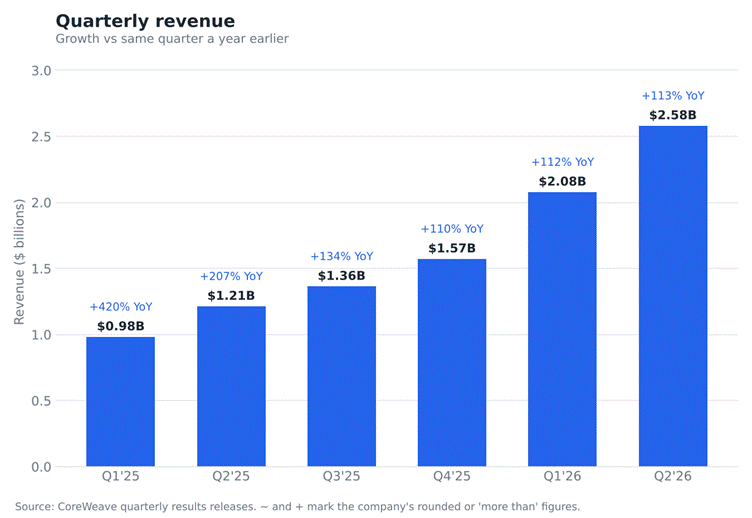
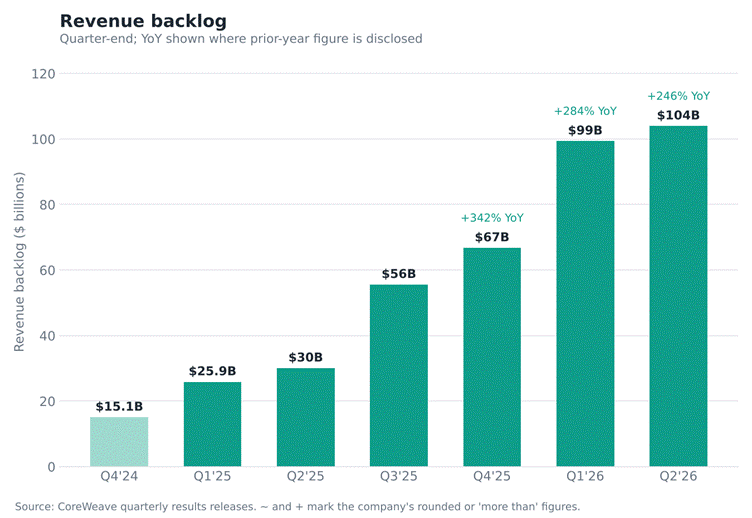
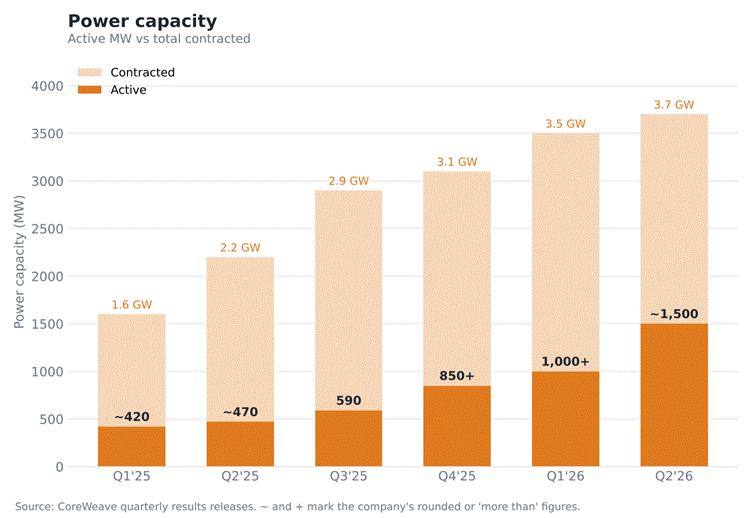
The growth has been explosive. Q2 2026 revenue reached about $2.58 billion, up from $1.21 billion a year earlier, and revenue backlog stood at roughly $104 billion. Active power capacity grew by about 500MW in the quarter to roughly 1.5GW, with about 3.7GW contracted in total.
But the demand for AI compute costs money, and the bill is large. A Nvidia B300 node, which holds 8 GPUs, easily costs around $600,000. 100MW can power roughly 6,400 B300 nodes, worth above $3.84 billion.
Despite its huge backlog, CoreWeave still posted a net loss of about $626 million in the quarter. Then in mid-October the stock fell 30% to $60.36, its lowest intraday level since May 2025. To see why, we need to look at how CoreWeave pays for its GPUs.
2. What is GPU financing, and how are cash flows shielded?
A GPU is expensive, and CoreWeave needs thousands of them. It doesn’t pay with cash but obtains financing for them, in a way that works like a mortgage on a rental property. Here’s how it works:
• CoreWeave signs a long-term GPU leasing contract with a customer, such as Meta
• It creates a separate legal entity (a Special Purpose Vehicle) for that project
• The SPV buys the GPUs and borrows money to do so. It pledges the GPUs as collateral, along with the customer service contracts.
• The customer’s payments go to the SPV first and pay the lenders back.
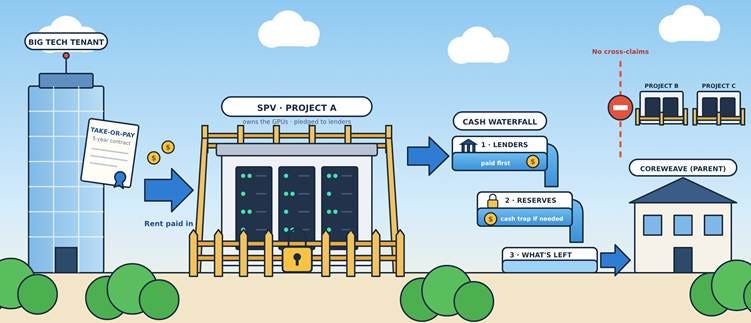
The SPV is designed to be separate from CoreWeave itself. The borrower in CoreWeave’s latest $8.5 billion facility is a bankruptcy-remote SPV set up to own the GPUs. If CoreWeave the parent company hits trouble, the lenders in that project have a claim on that project’s cash flows, not on the rest of the company, and the parent’s other creditors can’t reach that cash either.
The cash is also controlled. Revenue doesn’t go straight to CoreWeave. It passes through a “cash waterfall”, and a “cash trap” can lock cash in if conditions aren’t met.
This structure has won praise from rating agencies. The latest $8.5 billion loan is structured as non-recourse and ring-fenced to a dedicated entity. It earned investment-grade ratings of A3 from Moody’s and A (low) from DBRS Morningstar. The loan is split between a floating-rate tranche at SOFR + 2.25% and a fixed-rate portion at roughly 5.9%. Compare that with CoreWeave’s first loan in 2023, which was priced at around 15%.
Who are the lenders actually trusting? Mainly the customer. Morningstar noted the facility has “highly stable cash flows” from a take-or-pay contract with Meta, which requires payment regardless whether Meta uses the GPUs. In other words, lenders are lending against Meta’s credit, not CoreWeave’s.
The catch is that each facility is tied to a specific customer contract, so each tranche rests on a single counterparty.
3. Revenue mix and the risk
CoreWeave’s revenue depends heavily on a few customers:
• Microsoft made up approximately 67% of FY2025 revenue.
• In the June 2026 quarter, the largest customer was 36% of revenue, a second was 26% and a third was 10%. That’s about 72% from just three customers.
• OpenAI has contracted up to roughly $22.4 billion across multiple agreements.
• Meta committed an additional $21 billion during the quarter, and CoreWeave signed a multiyear deal to support Anthropic’s Claude models.
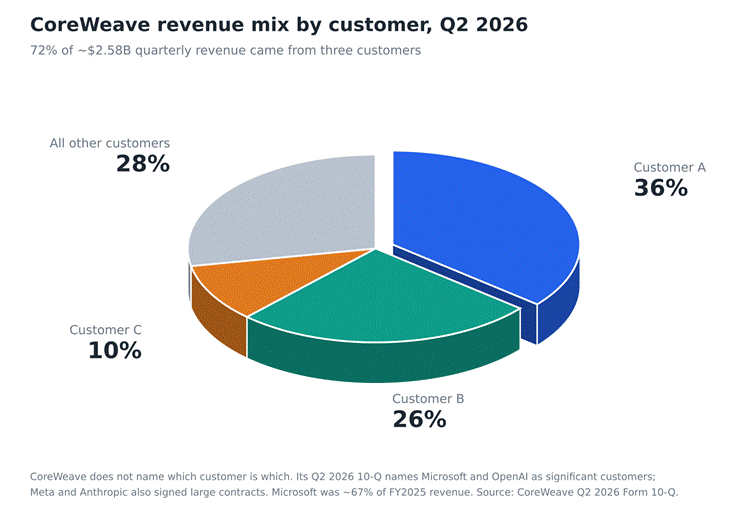
The mix is getting broader, which helps to diversify customer risk. Another risk is that CoreWeave’s biggest customers can also become its competitors. Microsoft, Meta and other large customers also operate or are developing infrastructure that can compete with specialized AI clouds.
There’s also a cost side. A big backlog doesn’t help if the interest bill eats the profit:
• Q2 revenue: about $2.58 billion
• Q2 net interest expense: about $640 million
• That’s roughly 25% of revenue going to interest alone.
And the spending isn’t slowing. The 2026 capital spending forecast was raised by $4 billion in August to a range of $35 billion to $39 billion.
4. Why bond yields spiked and bond prices crashed
First, a basic point that confuses many new investors: bond prices and bond yields move in opposite directions, like a seesaw. When people worry a company might not repay, they sell its bonds. The price falls, and the yield (the return a new buyer earns) rises. A “rising yield” and a “crashing price” are the same event. Read this article by Zee to learn more about treasury yields and Fed rates.
Here’s a simple example using CoreWeave’s 9.625% bonds due 2032:
• The bond has a face value of $1,000 and pays $96.25 a year in interest.
• At full price, a buyer earns about 9.6%.
• On October 14 the bond price fell to 78-81 cents on the dollar. At $800, that same $96.25 is a 12% return, and the buyer also gets back $1,000 at maturity. Together, that works out to roughly 15%.
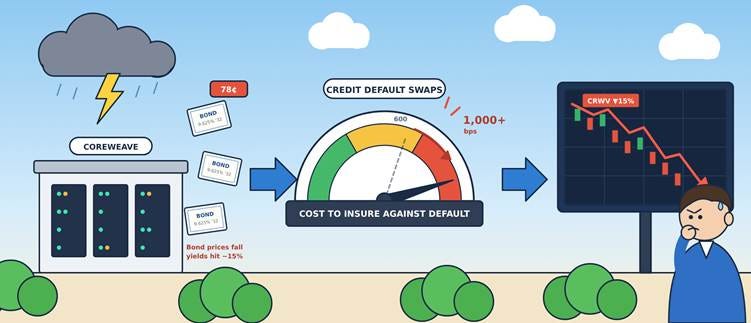
That is what happened. CoreWeave’s 9.625% senior unsecured notes due July 2032 hit a 15% yield intraday on October 13. That compares with an April issuance of $2.75 billion at a 9.75% coupon, when investors were still happy to lend.
The cost of Credit Default Swaps (CDS), which insures buyers against Coreweave’s default, rose above 1,000 basis points, up from above 600 the previous day. This means a CDS now costs above $10 annually to insure every $100 of debt.
Usually when a CDS rises above 1,000 basis points, the market expects a high likelihood of default, or the entity is already in deep financial trouble/restructuring.
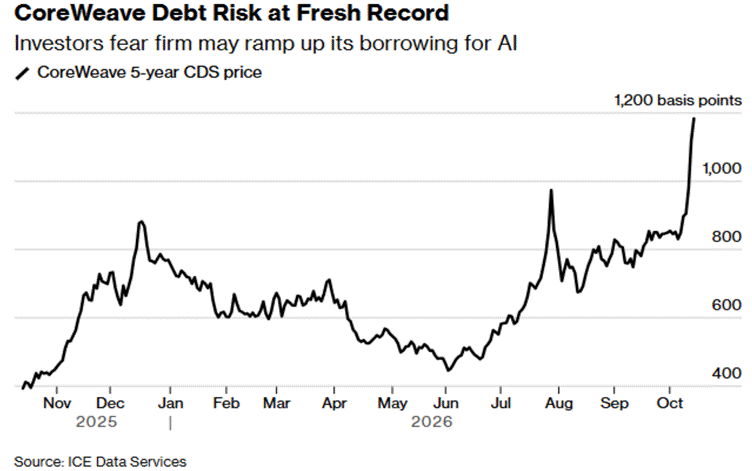
This isn’t just about CoreWeave. Alphabet, Amazon, Meta and Oracle had issued more than $228 billion of bonds this year, more than double their total for all of 2025, which fueled worries about debt-funded AI spending. The IMF named an AI share crash a “salient risk” to global financial stability in its October 2026 report.
One important nuance: these yields reflect market prices, not a reset of CoreWeave’s fixed coupons. CoreWeave’s existing bonds still pay the same interest. The pain comes when it needs to borrow new money. The CEO called the reaction irrational and pointed to the $104 billion backlog, and the bonds did bounce back, with the 2031 notes rising to 82.8 cents on the dollar.
They remain below face value, however.
5. Five-year GPU rates vs spot rates: what is CoreWeave missing out on?
When CoreWeave signs a customer, it locks in a price for years. CoreWeave’s weighted-average contract length is about 5 years. That certainty is what lenders want. But there’s a trade-off.
The price list looks like this for an Nvidia H100 GPU:
• On-demand list price: $6.16 per GPU-hour
• Spot price: about $2.46 per GPU-hour
• Best multi-year reserved rates: around $1.90 per GPU-hour (third-party estimate, since CoreWeave doesn’t publish contract rates)
Meanwhile, the market has moved up. SemiAnalysis tracked one-year H100 contract prices rising almost 40%, from $1.70 in October 2025 to $2.35 by March 2026. Bank of America pegged broad spot pricing at around $2.80 in August.
Then there’s the xAI comparison. Anthropic agreed to pay SpaceX (which now includes xAI) $1.25 billion a month for roughly 325,000 NVIDIA GPUs within xAI’s data centres. One analysis divided that by 220,000 GPUs and got $7.78 per GPU-hour. Using the 325,000 figure, it works out closer to $5.30. Either way, it is far above what CoreWeave’s long-term contracts are believed to earn.
Let’s do a simple illustration. Suppose CoreWeave has 100,000 GPUs running all year (8,760 hours), and assume a locked rate of $2.50 (not a disclosed figure):

On paper, that’s a lot of revenue left on the table. But it’s not a fair fight:
• The xAI contract bundles CPUs, storage and networking, and either side can cancel on 90 days’ notice after the first three months.
• Demand is never guaranteed. Chips sitting idle earn nothing.
• Coreweave’s lenders lend against the locked contract. Without it, there is no SPV financing.
There is an upside to locking in, too. One report says CoreWeave’s 2022-vintage H100 contracts rebooked at 95% of their original pricing on expiry. The CEO also said in August that 2020-vintage A100s were contracted out to 2029 at full pricing. Older chips are holding their value better than many feared.
6. What if CoreWeave can’t finance more clusters while yields stay high?
CoreWeave has promised far more capacity than it has built. Only about 1.5GW is active versus 3.7GWcontracted. Every extra GW needs funding first. A few things could happen:
• Best case: the ring-fence holds. Lenders keep funding contracted projects because they’re underwriting Meta or Microsoft, not CoreWeave. CoreWeave has already closed a $3.1 billion facility designed to allow secondary market trading. Growth continues, just at a higher cost.
• Middle case: slower growth. CoreWeave only builds what is fully funded. The backlog turns into revenue more slowly, while the interest bill on existing debt carries on. The company’s backlog depends on securing power, installing hardware and meeting customer specifications.
• Worst case: a funding squeeze. The parent company’s unsecured bonds are the weak link. At around 15% yields, refinancing them or raising new equity gets very expensive. That means more dilution for shareholders or asset sales to raise cash.
The parent company is the problem, not the individual projects. One ring-fenced facility earning an investment-grade rating doesn’t make the whole company investment grade. Amazon, Google and Microsoft can fund data centers from cash generated across large businesses, but CoreWeave relies on customer commitments and debt.
7. Why CoreWeave remains a risky bet
CoreWeave has real strengths: a huge backlog, blue-chip customers and a simple financing structure. But the risks stack up:
• Customer concentration: a handful of customers drive most revenue, and some are also potential competitors.
• Heavy debt: interest takes about a quarter of revenue, and it keeps borrowing to grow.
• Depreciation risk: Nvidia releases new chips so quickly that today’s collateral could be two generations old by the time a five-year loan matures. If collateral loses value faster than the contracts pay down the debt, lenders could be left short.
• Customer health: an October 8 selloff was linked to questions about OpenAI’s revenue trajectory. CoreWeave is only as strong as the customers paying it.
• Losses: analysts expect nearly $13 billion in 2026 revenue but a $2.13 billion loss.
The Bottom Line
CoreWeave sits at a crossroads where enormous demand meets a delicate funding model due to current high interest rates. If AI spending keeps growing and customers keep paying, the backlog could turn into real earnings, and the stock’s recent drop could look like a buying opportunity. But if credit markets stay shut, a company that must keep borrowing to grow could be forced to slow down or raise money on poor terms.
Investors who believe in the AI buildout and can stomach big swings may see a long-term opportunity. Those looking for stable, predictable returns may find the risks outweigh the rewards. The next quarterly results, expected in November, will be a key test.
Disclaimer:
All information here is for educational purposes only. This is not financial advice. Please do your own research and speak with a licensed advisor before making any investment decisions. Past performance is not indicative of future returns. How we invest may not suit your investment goals and risk management profile.